How to Specify Firestop in a Tender That Holds Up on Site
A firestop specification fails when it names a product instead of a performance. How to write the classification, evidence and substitution clauses properly.

In simple words
This one is written for whoever drafts and prices the document — procurement teams, contractors and consultants as much as buyers.
A firestop seal is only as good as the words that bought it. “60 minutes firestopping by an approved manufacturer” can be answered honestly with the cheapest reading of it, and by then the walls are closed.
- Ask for a class in letters and minutes, such as EI 120, not just a time.
- Require evidence covering your element type, thickness, service and opening size.
- Name the documents you want, and approve them before anything is ordered.
- Allow a substitution only if it is re-assessed in writing and approved before installation.
Then ask for two records: a schedule of every opening, and an as-built register of what was installed, where, by whom and when.
- Why a firestop specification fails
- Specify a classification, not a duration
- Require the tested arrangement, and its limits
- Demand the evidence pack by name
- The firestop schedule is the clause people forget
- The as built register, and why it now matters legally
- Make substitution a controlled event
- Separate supply from installation
- What to ask a supplier to produce before you order
- When we are not the right fit
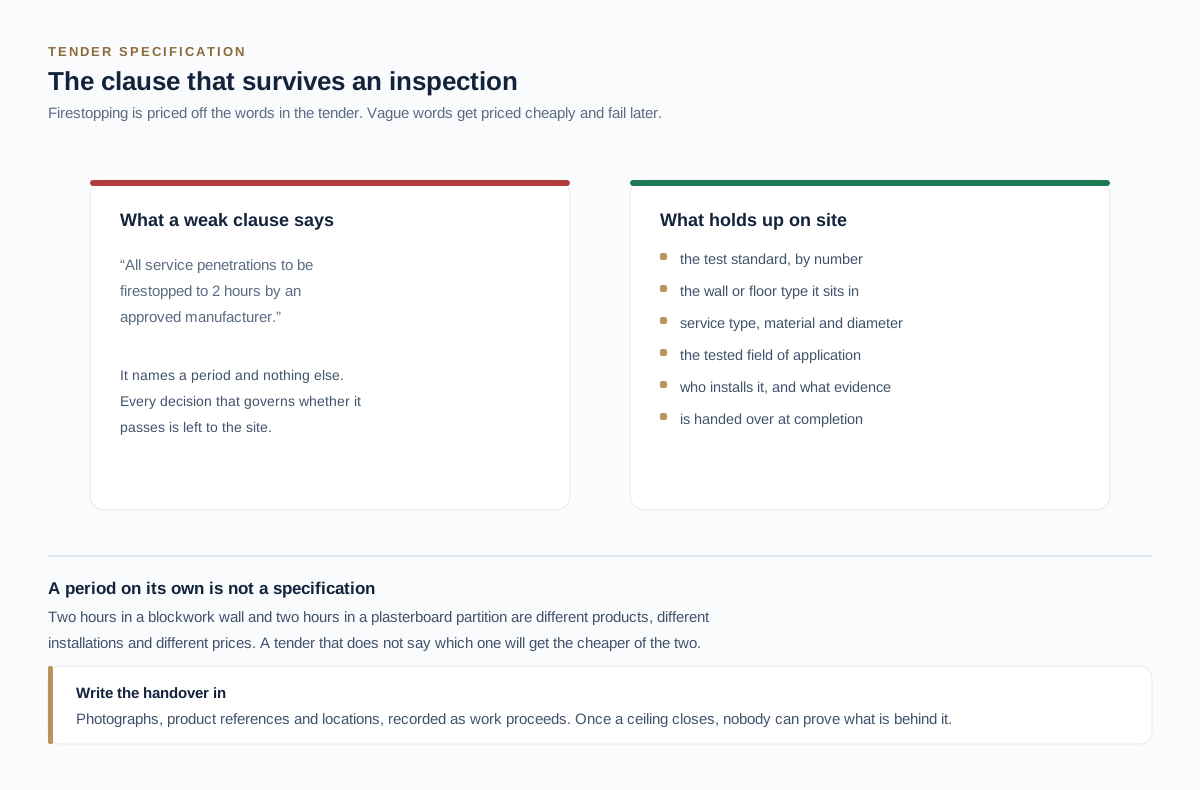
One line in a tender does more damage than any other: supply and install firestopping to achieve 60 minutes, product by an approved manufacturer. It looks finished. It has a time in it and it sounds like quality. On site it means whatever the cheapest honest reading of it means. By the time anyone argues, the walls are already closed.
How to specify firestop in a tender comes down to a single shift in thinking. A weak clause names a product. A strong clause names a performance and the tested arrangement that delivers it, then demands the paperwork that proves both. Get that right and the rest of the package polices itself.
This is written for the person drafting the document, not the person answering it. Simfy Exim supplies passive fire protection product into Europe and Africa, which means we read these documents from the tendering side every week and see exactly where they leak.
Why a firestop specification fails
It fails because nobody can check it. It gives a time but no class letters. It names a brand but not which product or which build-up. And it never asks anyone to hand over proof. That leaves three decisions to whoever is buying. Each one on its own looks reasonable. Together they change what actually gets built.

Consider what a contractor does with that opening line. Sixty minutes could mean integrity alone or integrity with insulation, and those are materially different products at materially different cost. An approved manufacturer is not defined anywhere in the document, so approval becomes self declared. And because no submittal is demanded before work starts, the first time anyone examines the evidence is at handover, when the only remedy left is opening finished construction. None of that is dishonesty. It is a document that asked a vague question and got a literal answer. The fix is not longer text. It is text that can be checked, item by item, by somebody who was not in the room when it was written.
Specify a classification, not a duration
Write it as a class: the letters and the minutes, against the standard that defines them. BS EN 13501-2:2023 is the document that turns test results into those classes. Ask for EI 120 (E is integrity, I is insulation, 120 is minutes) and anyone can check it. Ask for two hours and you have left the door open.
The letters carry the substance. Integrity is the ability to stop flame and hot gas passing to the unexposed side. Insulation is holding the temperature of that unexposed side below a limit. A penetration (an opening where a pipe or cable crosses a wall) that keeps flame back but runs hot can still set fire to what leans against the wall in a stairwell. Deciding which of those you need is a design decision belonging in the specification, not a pricing decision belonging to a subcontractor. Where legacy evidence appears, be explicit about which regime governs. In the United Kingdom, BS 476-20:1987, the method for determination of the fire resistance of elements of construction, still turns up in existing building records, and Approved Document B is withdrawing those national classes in favour of the BS EN 13501 series. A document that accepts either, without saying so, will receive both.
Require the tested arrangement, and its limits
Performance alone is still not enough. The classification attaches to a whole tested arrangement: the element type and thickness, the service, the opening size, the depth of material and the backing. The clause has to require evidence covering the construction actually on your drawings.
BS EN 1366-3:2021 is unusually direct about this. It sets out criteria for evaluation including field of direct application rules, which define how far a laboratory result may be extended before fresh testing or a written assessment becomes necessary. It also states that supporting constructions represent separating elements such as walls or floors, simulating the interaction between the test specimen and the element the sealing system will sit in. Linear gaps are a separate question again, handled by BS EN 1366-4:2021, which assesses joint seals by intended end use, both with and without mechanically induced movement, and excludes curtain walling perimeter seals. So the clause should name the parts that apply. Requiring evidence to BS EN 1366-3:2021 for penetrations and BS EN 1366-4:2021 for movement joints removes the single most common gap in these packages.
| What to write | What the weak version says | Why the weak version fails on site |
|---|---|---|
| Seals to achieve EI 120 classified to BS EN 13501-2:2023 | Two hour fire stopping | Integrity only product is offered and is technically compliant with the words used |
| Evidence to BS EN 1366-3:2021 covering the element type, thickness and service on the drawings | Tested to relevant standards | A report for a concrete floor is submitted against a lightweight partition |
| Movement joints classified with evidence to BS EN 1366-4:2021 including induced movement | Seal all gaps | A static penetration detail is used in a joint that moves, and cracks in the first year |
| Declaration of performance required per delivered product code before ordering | Certified products only | Certification is self declared and never produced |
| Firestop schedule submitted and approved before first fix | Contractor to coordinate services | Nobody holds a list of penetrations, so nobody can confirm any were sealed |
| Any substitution re-assessed in writing and approved before installation | Or equal and approved | Equivalence is judged on the tube label, not the tested arrangement |
| Supply scope and installation scope priced and warranted separately | Supply and install firestopping | A product defect and a workmanship defect become one unresolvable argument |
Demand the evidence pack by name
Third party certification means an independent body assessed the product against a standard and continues to check it. That is different from a manufacturer stating a result. Name the documents you want, say when they must arrive, and make approval of them a condition precedent to ordering.
For product placed on the European market the anchor document is defined in law. Regulation (EU) No 305/2011, the Construction Products Regulation, requires in Article 4(1) that a manufacturer shall draw up a declaration of performance (the manufacturer’s signed statement of what the product does) when a product covered by a harmonised standard (a shared European product standard the rules point to) is placed on the market. Article 6(1) requires the declaration to express performance against the essential characteristics, and Article 6(3)(c) requires performance for at least one essential characteristic relevant to the declared intended use. Article 8(2) closes the loop: where no declaration has been drawn up under Articles 4 and 6, the CE marking (the mark showing an EU conformity route was followed) shall not be affixed. For projects in Great Britain, GOV.UK guidance on the Construction Products Regulation confirms that harmonised European standards became designated standards, and that a product carrying both UKCA (Britain’s own conformity mark, introduced after Brexit) and CE marks needs valid declarations satisfying both regimes.
| Document | What it proves | Who issues it |
|---|---|---|
| Declaration of performance | Declared performance against essential characteristics for a stated intended use | The manufacturer, under Regulation (EU) No 305/2011 |
| Classification report | The class in letters and minutes, against BS EN 13501-2:2023 | A notified or approved body |
| Test or assessment report | The exact arrangement that was tested, and its field of application | The testing laboratory |
| Installation detail sheet | The configuration the evidence actually covers | The manufacturer |
| Firestop schedule | Every penetration, its location, service and required class | The contractor, approved by the design team |
| As built register with photographs | What was installed, where, by whom and on what date | The installing contractor |
The firestop schedule is the clause people forget
A schedule is a live list of every opening through every compartment line, with location, service, element type, required class and the approved detail against each one. Without it there is no denominator. You cannot report that sealing is complete if nobody agreed how many there were.
Ask for it early, before first fix, and ask for it to be updated as services change, because they always do. The schedule is what turns an argument about quality into an arithmetic check. It also carries the coordination problem into the open, since a partition with fourteen services through it is a design issue rather than a sealing issue, and it is far cheaper to move a service on paper. Make the schedule a submittal with a named approver and a date, not an appendix that appears at handover. On multi building programmes this is also the document that lets a buyer aggregate real quantities across sites, which is where our sourcing and supply solutions become useful rather than theoretical.
The as built register, and why it now matters legally
The register records what was actually installed against the schedule: location, product, batch, detail reference, installer and date, with photographs taken before the opening was closed. In the United Kingdom this has moved from good practice to a duty on higher risk buildings.
The Building Safety Act 2022 created the building safety regulator and set duties around higher risk buildings, including registration, certificates and accountable persons, alongside provisions on construction product liability. GOV.UK guidance on keeping information about a higher risk building describes the golden thread as a digital record that acts as a building single source of truth, kept accessible and written in plain English, and places that duty on clients, principal designers, principal contractors and accountable persons. Firestopping evidence is exactly the kind of information that ends up in it. Specifying the register at tender stage costs nothing. Reconstructing it two years later, from memory and a folder of delivery notes, is close to impossible, and the photographs that would have settled it no longer exist because the ceilings went in.
Send us the EI classification and the conditions. We come back with product that carries the evidence.
Make substitution a controlled event
Or equal and approved is the weakest phrase in construction procurement. Write instead that any alternative must be submitted with its own classification report and evidence covering the same element type, service and opening size, and approved in writing before installation.
The reason is technical rather than contractual. Because a class attaches to the arrangement that was tested, swapping in a different material at the same stated minutes changes the configuration unless separate evidence covers it. Two products can hold identical classifications and still be assessed in different wall constructions. The clause should therefore ask for the report, not the assurance. It should also name who approves, because a substitution approved by a site manager under time pressure is how a compliant specification becomes a non compliant building. Buyers who want the comparison done properly before an order is placed can send both options to Simfy Firesys and get the evidence read against the actual drawings.
Separate supply from installation
Bundling product and labour into one line hides the two most common failure modes behind each other. Price them separately, warrant them separately, and say plainly which party carries which risk. It also lets a client buy product centrally across several sites while labour stays local.
When a seal fails, there are only two possible causes: the wrong product was supplied, or the right product was installed outside its tested arrangement. A single combined line gives the responsible party an incentive to keep that question unanswered. Splitting the scopes forces the evidence to sit with the supply package, where it can be checked before delivery, and forces the installation method statement to reference the approved detail sheet. It also removes an argument that has become common on tenders using centrally purchased product, where a contractor declines responsibility for goods it did not select. Say who selects, who supplies, who installs and who verifies, in four sentences, near the front of the document. Our working process is written around that split, because it is the one we operate on.
What to ask a supplier to produce before you order
Put these in the tender as submittals rather than requesting them later. A supplier who cannot produce them at enquiry stage will not produce them at delivery either.
- The declaration of performance for each product code you intend to buy, matched to packaging
- The classification report showing the class in letters and minutes and the standard it was issued against
- The underlying test or assessment report, so the tested arrangement can be read in full
- Installation details covering every element type on your drawings, including the awkward ones
- Confirmation of the manufacturing site, with the option of a factory audit and pre shipment inspection
- Batch marking and shelf life terms, with a minimum remaining life on delivery
If a market outside Europe governs the project, ask which evidence the local authority accepts before the enquiry goes out. Certification regimes differ between European and African markets, and in the United States a separate framework applies, where ASTM E814-26, the Standard Test Method for Fire Tests of Penetration Firestop Systems, produces an F rating based on flame occurrence on the unexposed surface and a T rating based on temperature rise as well as flame. Deciding that at drafting stage is a paragraph. Deciding it at customs is a delay.
When we are not the right fit
We supply and source product. We do not install, we are not a fire stopping contractor, and we do not survey buildings, write method statements or sign off workmanship. If your tender needs an installer, a competent person to certify installed work, or a remedial survey of existing penetrations, we are not that company and we will tell you at the first enquiry rather than the third meeting.
We are also careful about what certification means on our side. Any approval or listing sits with the manufacturers who make the goods. We do not hold it and we do not present it as ours. What we contribute is requirement led sourcing against a written specification, supplier verification, factory audit and pre shipment inspection where wanted, and open book pricing so you can see what you are paying for.
Knowing how to specify firestop in a tender is mostly a drafting discipline. If you are drafting a package now and want the evidence requirements checked before it goes out, send the specification and drawings through our requirement form. Common questions are answered on our frequently asked questions page, and if it is easier to talk it through, reach the team directly.
What should a firestop specification actually say?
It should state the required class in letters and minutes against BS EN 13501-2:2023, require evidence to BS EN 1366-3:2021 for penetrations and BS EN 1366-4:2021 for linear joints covering your element types, require a declaration of performance per product code, require a schedule and an as built register, and control substitution in writing.
Should the tender name a brand?
Naming a brand alone leaves the configuration undefined, which is where the risk sits. If procurement rules require a reference product, state it as an indicative example and put the binding requirement in the classification and the evidence clauses, so any alternative is judged against the same tested arrangement rather than against a label.
What is third party certification and why insist on it?
It means an independent certification body assessed the product against a standard and continues to monitor it, rather than the manufacturer declaring a result unchallenged. Insisting on it in the tender gives you a document from a named body that can be checked, and it filters out suppliers whose evidence exists only as a brochure claim.
Is a declaration of performance the same as a certificate?
No. Under Regulation (EU) No 305/2011 the declaration of performance is drawn up by the manufacturer and states declared performance against essential characteristics for an intended use. A classification report is issued by a body and states the class achieved. A complete submittal contains both, plus the test report underneath them.
Who is liable if a seal fails inspection?
It depends which scope caused it, which is precisely why supply and installation should be separated and warranted separately in the document. If the product matched the approved submittal and the installation departed from the approved detail, that is a workmanship question. If the delivered product never matched its evidence, it is a supply question.
How do I stop substitution happening quietly on site?
Replace or equal and approved with a clause requiring a full submittal for any alternative, covering the same element type, service and opening size, approved in writing by a named person before installation. Add a requirement that the as built register records the product actually used, so a silent change becomes visible at the next audit.
What is a firestop schedule and who produces it?
It is a list of every penetration and joint through compartment lines, with location, service, element type, required class and approved detail. The contractor normally produces it and the design team approves it. Requiring it before first fix, and requiring updates as services change, is what makes completion measurable.
Does this apply outside the United Kingdom and Europe?
The drafting principles carry across, but the accepted evidence does not. European classification, United States ratings under ASTM E814-26 and national approvals in African markets are separate regimes. State in the tender which one governs, and require evidence issued under that regime rather than assuming a certificate from elsewhere will be accepted.
Sources
- BS EN 13501-2:2023, fire classification using data from fire resistance and smoke control tests
- BS EN 1366-3:2021, fire resistance tests for service installations, penetration seals
- BS EN 1366-4:2021, fire resistance tests for service installations, linear joint seals
- BS EN 1363-1:2020, fire resistance tests, general requirements
- Regulation (EU) No 305/2011, the Construction Products Regulation, full text on EUR-Lex
- Construction Products Regulation in Great Britain, GOV.UK guidance, United Kingdom
- Using the UKCA marking, GOV.UK guidance, United Kingdom
- Building Safety Act 2022, legislation.gov.uk, United Kingdom
- Keeping information about a higher risk building, the golden thread, GOV.UK, United Kingdom
- Approved Document B, fire safety, GOV.UK, United Kingdom
- BS 476-20:1987, fire resistance of elements of construction, general principles, United Kingdom
- ASTM E814-26, Standard Test Method for Fire Tests of Penetration Firestop Systems, United States
Declaration of Performance, classification report, and the tested system the product sits inside.