Intumescent Sealant: How It Works and Where It Belongs
Intumescent sealant swells under heat to close a gap. See how it differs from ablative and acrylic, and why its EI rating only holds in a tested system.
In simple words
Intumescent sealant sits in a gap like ordinary flexible filler. When heat reaches it, it swells to many times its size and hardens into a crust that closes the space left behind as plastic pipes and cables soften and burn away.
The part that costs money to get wrong: the fire rating does not belong to the tube. It belongs to the whole tested arrangement — that wall type and thickness, that service, that gap size, that depth of material and that backing.
So do not buy “60 minutes”. Buy evidence that covers the wall, the service and the gap size you actually have, and match the product code on the paperwork to the code printed on the cartridge.
- How intumescent sealant works when a fire starts
- Intumescent vs ablative, and where plain acrylic belongs
- The letters after the rating carry the real meaning
- Different regions, different letters, same underlying question
- The rating belongs to the system, not to the tube
- Penetration seals and linear joints are separate tests
- What a real document pack looks like
- Buying it well across borders
- Three things that go wrong between order and delivery
- When we are not the right fit
A certificate turns up with the delivery. It has a fire rating, a lab reference and a logo. What it does not have is your wall, your pipe, or the size of the gap around that pipe. That difference between the paper and the real hole is where sealed openings go wrong, long before there is any fire.
This product is bought on trust more than almost anything else on a building. It goes in, it gets painted over, and nobody looks at it again until an inspector cuts a piece out or a fire finds the weak spot. So the decision has to be right when you order it, not at the end when somebody is walking round with a snag list.
This guide explains what intumescent sealant (a filler that swells shut when it gets hot) actually does under heat, how it differs from ablative (a material that soaks up heat and slowly burns back) and from ordinary acrylic or silicone, and why a rating printed on a tube means very little on its own. Simfy Exim supplies passive fire protection products into Europe and Africa, so the questions below are the ones our buyers ask before they place an order.
How intumescent sealant works when a fire starts
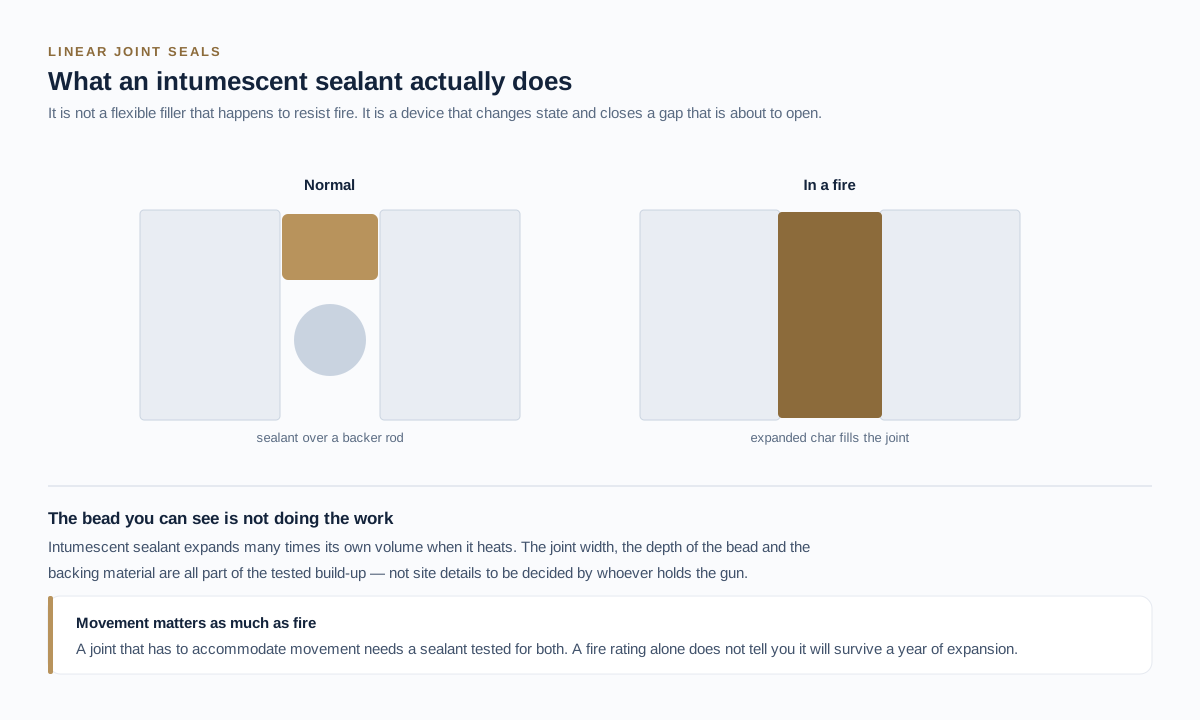
Most of the time it just sits in the joint like ordinary flexible filler. Then heat reaches it. It swells to many times its normal size and hardens into a black crust. That crust fills the space left behind as plastic pipes soften and collapse, and it holds back flame, hot gas and smoke.
The reaction matters because of what burns first. A plastic waste pipe or a bundle of cables does not stay put in a fire. It softens, sags and disappears, leaving a clean hole straight through a wall that was supposed to be a barrier. An inert filler would simply sit in the gap while the hole grew around it. An expanding compound does the opposite: as the service shrinks, the seal grows into the space the service has vacated. The chemistry behind this is measured in a furnace, not on a site. BS EN 1363-1:2020 sets out the general principles for determining fire resistance under standard exposure conditions, including the temperature and time curve that every one of these tests follows, so results from separate laboratories can be compared honestly.
Intumescent vs ablative, and where plain acrylic belongs
There are two different products here. One type wears itself away on purpose. It soaks up heat, gives off moisture and slowly burns back, keeping the other side of the wall cool. The other type swells up and closes the hole. One cools, the other grows. They fail in different ways, so you cannot swap one for the other on a drawing.
Ordinary acrylic and silicone belong to a different family altogether. They are movement and weather products. BS EN 15651-1:2012 covers sealants for facade elements, for exterior wall joints and around window and door perimeters, and explicitly excludes materials used in internal walls and partitions. BS EN ISO 11600:2003+A1:2011 classifies jointing products by type and movement capability. Neither of those standards asks the material to survive a furnace. A tube marked to a jointing classification tells you how far the joint can move without splitting. It says nothing about what happens at several hundred degrees, which is the question a barrier has to answer.
| Material | Behaviour under heat | Where it belongs | Where it fails |
|---|---|---|---|
| Intumescent | Swells and chars, closing the aperture as combustible services burn back | Plastic pipes, cable bundles, mixed services where the penetrating item will disappear | Used where there is nothing to close, or squeezed into a gap too small for the char to develop |
| Ablative | Erodes and releases moisture, holding the unexposed face cooler for longer | Cable trays and openings that stay dimensionally stable in fire | Relied on to shut a hole left by a melted plastic service |
| Fire resistant silicone | Holds integrity while accepting joint movement | Linear gaps and movement joints between rigid elements | Substituted for a penetration seal around combustible services |
| General acrylic or silicone | Softens, shrinks and burns out | Decorative and weather joints outside any barrier | Anywhere a compartment line is drawn |
The letters after the rating carry the real meaning
A European classification is written as letters followed by minutes. E covers integrity, the ability to stop flame and hot gas crossing to the cold side. I covers insulation, keeping the unexposed face below a temperature limit. EI 120 asks for both for two hours. E 120 alone asks for far less.
BS EN 13501-2:2023 is the standard that turns furnace data into those classifications, covering loadbearing elements, fire separating elements, protective systems and non loadbearing components. The distinction between the two letters is not academic. A seal that holds integrity but not insulation can still be hot enough on the escape corridor side to ignite what is stacked against the wall. Specifications that ask only for a number of minutes, with no letters, leave that choice to whoever prices the package. In the United Kingdom, older ratings under BS 476-20:1987, which sets the general principles for determining the fire resistance of elements of construction, still appear in existing records. Approved Document B is withdrawing those national classes in favour of the BS EN 13501 series, so mixed evidence in one document is now a live risk rather than a tidy-up job.
Different regions, different letters, same underlying question
Buyers working across our supply markets in Europe and Africa hit this quickly. A product certified for one regime does not automatically carry across to another, and the letters do not translate one for one. In the United States, ASTM E814-26, the Standard Test Method for Fire Tests of Penetration Firestop Systems, produces an F rating based on flame appearing on the unexposed surface and a T rating based on temperature rise as well as flame, and includes a hose stream stage that the European route handles differently.
| Regime | Reference standard | How performance is expressed |
|---|---|---|
| Europe | BS EN 13501-2:2023, tested to BS EN 1366-3:2021 or BS EN 1366-4:2021 | Letters and minutes, for example EI 120 |
| United Kingdom, legacy evidence | BS 476-20:1987 and the related parts of that series | Minutes against integrity, insulation and stability criteria |
| United States | ASTM E814-26 | F rating and T rating, in hours |
| International | ISO 10295-1:2026 for penetration seals, ISO 10295-2:2009 for linear joint and gap seals | Test route, not a national class |
The rating belongs to the system, not to the tube
A fire rated sealant has no classification of its own in use. The classification belongs to the whole assembly that went into the furnace: that wall type, that thickness, that service, that annular gap, that depth of material and that backing. Change one of those on site and the evidence no longer describes what was built.
BS EN 1366-3:2021 makes this explicit rather than implied. It sets out criteria for evaluation including field of direct application rules, which define how far a result can be stretched before a fresh test or an assessment is needed. It also explains that supporting constructions are used to represent separating elements such as walls or floors, and that these simulate the interaction between the test specimen and the element the sealing system will sit in. That is the sentence buyers should read twice. The laboratory did not test a cartridge. It tested a configuration, and that configuration is the product. This is also why a substitution agreed verbally on site, with a similar looking material at the same stated minutes, is a change of specification, not simply a change of supplier.
Penetration seals and linear joints are separate tests
A hole with something running through it and a continuous gap between two building elements behave differently under heat and are assessed under different parts of the same series. Evidence written for one does not cover the other, even when the material in the cartridge is identical.
BS EN 1366-3:2021 addresses the ability of a penetration seal (the seal around a pipe or cable that crosses a wall) to maintain the fire resistance of a separating element where services pass through it, assessing integrity and insulation. It excludes chimneys, air ventilation systems and fire rated ducts, which sit under other references entirely. BS EN 1366-4:2021 covers linear joint seals (the seal along a continuous gap between two building elements) and determines fire resistance based on intended end use, with tests both without mechanically induced movement and with it, while excluding perimeter seals of curtain walling. That movement clause matters on real buildings, where slabs deflect and joints open and close through the year. The international route mirrors the same split, with ISO 10295-1:2026 for penetration seals and ISO 10295-2:2009 for linear joint and gap seals. Ask which part the evidence was written against before you compare two offers.
Intumescent, ablative and elastomeric each belong somewhere different. Tell us the joint and we will tell you which.
What a real document pack looks like
Certification is a document trail, not a logo. For a product placed on the European market the anchor document is a declaration of performance, and it is the manufacturer who draws it up and stands behind it. Without that declaration there is nothing to check a delivery against.
Regulation (EU) No 305/2011, the Construction Products Regulation, states in Article 4(1) that a manufacturer shall draw up a declaration of performance (the manufacturer’s signed statement of what the product does) when a product covered by a harmonised standard (a shared European product standard the rules point to) is placed on the market. Article 6(1) requires that declaration to express performance in relation to the essential characteristics, and Article 6(3)(c) requires the performance of at least one essential characteristic relevant to the declared intended use. Article 8(2) is blunter: if a declaration has not been drawn up in accordance with Articles 4 and 6, the CE marking (the mark showing an EU conformity route was followed) shall not be affixed. For Great Britain, the government guidance on the Construction Products Regulation confirms that harmonised European standards became designated standards, and that a product carrying both marks needs valid declarations meeting both regimes. Our approach to documentation and supplier verification starts from those articles, not from a brochure.
Before you release an order, ask for these against the exact reference you are buying:
- The declaration of performance, matched to the product code on the packaging
- The classification report naming the standard and the classified performance in letters and minutes
- The test or assessment report behind it, so you can read the tested configuration
- The installation detail for your wall type, service type and gap size
- Shelf life and batch marking, because an expanding compound is a chemistry that ages
Buying it well across borders
Certification regimes are the part that catches distributors out. A European declaration is not a United States listing, and neither is automatically accepted by an authority that works to a third framework. Several African markets accept European or international evidence but expect the paperwork to arrive with the goods, complete, in English, and traceable to the batch delivered. That is a documentation problem, not a product problem, and it is fixable at the purchase order stage.
It is also the point where price comparisons stop being like for like. Two quotations at the same stated minutes can rest on completely different evidence, one with a classification report covering the wall type you actually have, the other with a report covering a masonry wall when your project is lightweight partition. How we work is built around closing that gap before anything ships, including factory audit and pre shipment inspection where a buyer wants eyes on the line.
Three things that go wrong between order and delivery
Most disputes on a firestop package are not about whether the product performs. They are about whether the product delivered is the one the evidence describes. Three failures account for most of them, and all three are visible at the purchase order stage if somebody looks.
The first is a document that covers a sister product. Manufacturers run families of grades under close names, and an intumescent sealant in a family can share branding with an acrylic grade that was never near a furnace. Match the product code on the declaration to the code on the cartridge, character by character.
The second is evidence written for the wrong element. A classification covering a 200 mm concrete floor tells you nothing useful about a 100 mm lightweight partition, and BS EN 1366-3:2021 ties the result to the supporting construction that was used in the test.
The third is age. An expanding compound is a chemistry with a shelf life, and stock that has sat in a hot container for a season is not the material the laboratory assessed. Ask for batch dates before shipment, not after. Buyers running multi country programmes through our Simfy Firesys division tend to write all three into the order as conditions of acceptance, which costs nothing and settles the argument in advance.
When we are not the right fit
We supply and source product. We do not install it, we are not a fire stopping contractor, and we do not carry out site surveys or issue installation certificates. If what you need is a trained installer, a remedial survey of existing penetrations, or somebody to sign off workmanship on your building, we are the wrong call and we will say so on the first email.
We should also be clear about what certification means in our hands. Products we supply carry the certification held by the manufacturers who make them. That evidence belongs to those manufacturers, and we pass it through to you intact rather than claiming it as ours. What we add is requirement led sourcing, supplier verification and open book pricing, so you know which factory is making your goods and on what terms.
If that is what you need, send the specification, the wall types and the services involved through our requirement form and we will come back with options and the documents behind them. If you would rather talk it through first, our team is reachable directly.
What is the difference between intumescent sealant and ordinary acrylic sealant?
An expanding fire grade compound reacts to heat by swelling and forming a char that closes the opening. Ordinary acrylic is a movement and decorative product. BS EN 15651-1:2012 covers facade sealants and excludes internal wall and partition use, and BS EN ISO 11600:2003+A1:2011 classifies jointing products by movement capability. Neither addresses furnace performance.
Is intumescent or ablative better for cable penetrations?
It depends on what happens to the service in a fire. Cables on a stable steel tray may suit an ablative approach that keeps the cold face cooler. Bundles with heavy plastic content leave a void as they burn back, and that void has to be closed by something that grows. The tested detail for your configuration settles it, not a general preference.
Does a fire rated sealant carry its own EI rating?
No. Classification under BS EN 13501-2:2023 applies to the tested assembly, not to the material in isolation. BS EN 1366-3:2021 includes field of direct application rules that define how far a result can be taken. Ask which wall construction, service and gap size the report covers before treating a number as transferable.
Will it pass inspection?
Inspection compares what was built against the evidence supplied. Product with a complete document pack, installed to the detail that matches the tested configuration, is straightforward to sign off. Product with a certificate for a different wall type is where arguments start, and that is a specification and supply chain issue, not a workmanship one.
How do I know a certificate is genuine?
Check that the product code on the declaration of performance matches the packaging, that the classification report names the standard and the classified performance, and that the issuing body is identifiable and traceable. Regulation (EU) No 305/2011 requires the manufacturer to draw up the declaration, so the document should lead back to a named manufacturer, not a trading name.
What happens if a detail is substituted on site?
Substitution moves the installation outside the evidence unless the alternative is covered by its own tested configuration or a written assessment. Because BS EN 1366-3:2021 ties results to the configuration tested, a change of wall type, gap size or depth of material is a technical change. It needs to be re-assessed and recorded, never agreed by conversation.
Can one product cover both penetrations and linear joints?
Some materials are assessed under both routes, but the evidence has to say so. BS EN 1366-3:2021 covers penetration seals and BS EN 1366-4:2021 covers linear joint seals, including movement conditions. Ask for the classification against each part you intend to use, instead of assuming one report covers both applications.
Do European certificates work in African markets?
Requirements differ by country, and acceptance is a matter for the authority on the project. Many buyers in our markets work to European or international evidence and expect the full pack to travel with the goods. Confirm the accepted regime before you order, because retro fitting documentation after shipment is the expensive way to do it.
Sources
- BS EN 1366-3:2021, fire resistance tests for service installations, penetration seals
- BS EN 1366-4:2021, fire resistance tests for service installations, linear joint seals
- BS EN 13501-2:2023, fire classification using fire resistance test data
- BS EN 1363-1:2020, fire resistance tests, general requirements
- BS 476-20:1987, fire resistance of elements of construction, general principles, United Kingdom
- ASTM E814-26, Standard Test Method for Fire Tests of Penetration Firestop Systems, United States
- ISO 10295-1:2026, fire testing of service installations, penetration seals
- ISO 10295-2:2009, fire testing of service installations, linear joint and gap seals
- BS EN 15651-1:2012, sealants for non structural use, facade elements
- BS EN ISO 11600:2003+A1:2011, jointing products, classification and requirements for sealants
- Regulation (EU) No 305/2011, the Construction Products Regulation, full text on EUR-Lex
- Construction Products Regulation in Great Britain, GOV.UK guidance, United Kingdom
- Approved Document B, fire safety, GOV.UK, United Kingdom
We source to a stated specification and can arrange factory audit and pre-shipment inspection.