Passive Fire Protection: Systems, Ratings and Tests
Passive fire protection explained for buyers: what EI ratings mean, which test applies to each product family, and why a rating belongs to a tested system.
- What passive fire protection actually means
- Active vs passive fire protection, and why a building needs both
- Compartmentation is the idea everything else serves
- Passive fire protection products, and the test each family answers to
- How performance is proved
- The part most pages leave out: the rating belongs to a system
- What a certificate covers, and what it does not
- Older and newer test regimes still sit side by side
- Buying across markets without losing the classification
- Where we fit, and where we do not
A wall is only as good as the last hole somebody drilled in it. On paper it holds fire for two hours. On site, a cable tray went through it on a Friday. The gap got filled with whatever was in the van. Nobody wrote it down. That gap is where the plan stops and the guessing starts. This guide is for the people who buy the product, not the people who fit it.
We supply fire protection products to contractors, distributors and developers across Africa, Europe and the United States. Reading certificates is most of our day. This page shows you how to read one properly, and the one thing that decides whether a seal will do what the drawing promised. The range behind this sits on our passive fire protection product pages.
What passive fire protection actually means
Passive fire protection is the part of a building that fights fire without anyone turning it on. Walls, floors, doors, the seals around pipes and cables, the coating on steel beams. Its job is to keep the fire in the room where it started, for a set number of minutes. That gives people time to get out, and keeps the building standing while they do.
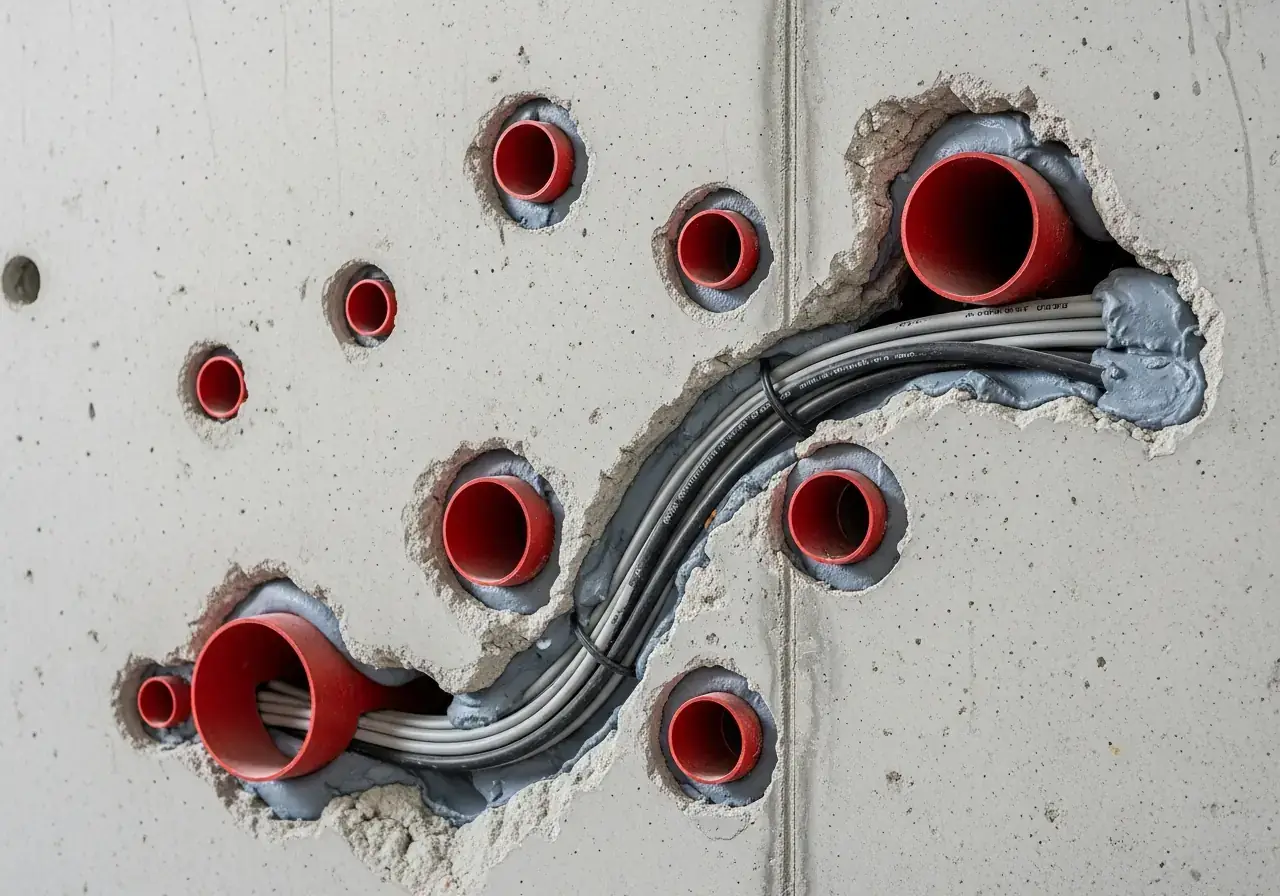
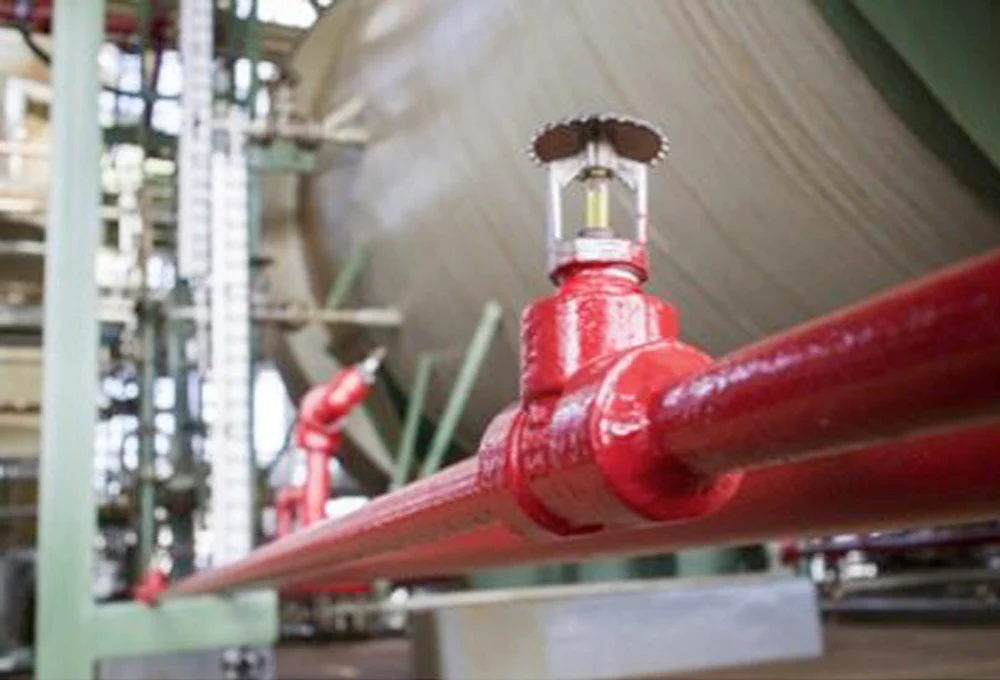
The word passive is doing real work. Nothing detects, nothing triggers, nothing needs power or water. The performance is built into the material and the way it was assembled, and it sits there for the life of the building doing nothing at all until the day it matters. That is its strength and its weakness in one. A sprinkler head painted over will usually be spotted. A missing collar behind a plasterboard patch will not, because there is nothing to inspect unless somebody opens it up. Under Regulation (EU) No 305/2011, the Construction Products Regulation, safety in case of fire is one of the basic requirements construction works must satisfy, covering both the stability of the structure during a fire and the limitation of fire spread. Every product family below exists to serve one of those two aims.
Active vs passive fire protection, and why a building needs both
Active systems spot a fire and act. Alarms ring, sprinklers open, fans pull the smoke out, dampers shut. Passive systems do nothing at all. They just hold. A building needs both, and the fire plan decides how much of each. One cannot replace the other, however tempting that looks when somebody is cutting costs.
The honest way to think about it is timing. Active measures buy the first minutes by raising the alarm and slowing growth. Built-in protection buys the hour after that, by keeping the fire in one compartment while people walk out and the fire service walks in. The two are designed together, which is why substituting one for the other mid-project is a design decision and not a purchasing one. BS 7974:2019, the code of practice for applying fire safety engineering principles to the design of buildings, sets out the framework used when a project is designed on performance rather than on prescriptive guidance, and it covers new buildings and existing ones. If a project follows that route, the balance between detection, suppression and compartment integrity has already been calculated. Changing one side of it on site changes the answer.
| Attribute | Active systems | Passive systems |
|---|---|---|
| How it acts | Detects and responds | Present and inert until fire reaches it |
| Needs power or water | Usually yes | No |
| Typical examples | Alarms, sprinklers, smoke extract, dampers | Compartment walls, doors, seals, coatings, boards |
| Main job | Warn people, slow fire growth | Contain fire, protect structure |
| Failure mode | Component or supply failure | Wrong detail, wrong material, unrecorded change |
| How it is verified | Commissioning and periodic testing | Test evidence, inspection before it is covered up |
Compartmentation is the idea everything else serves
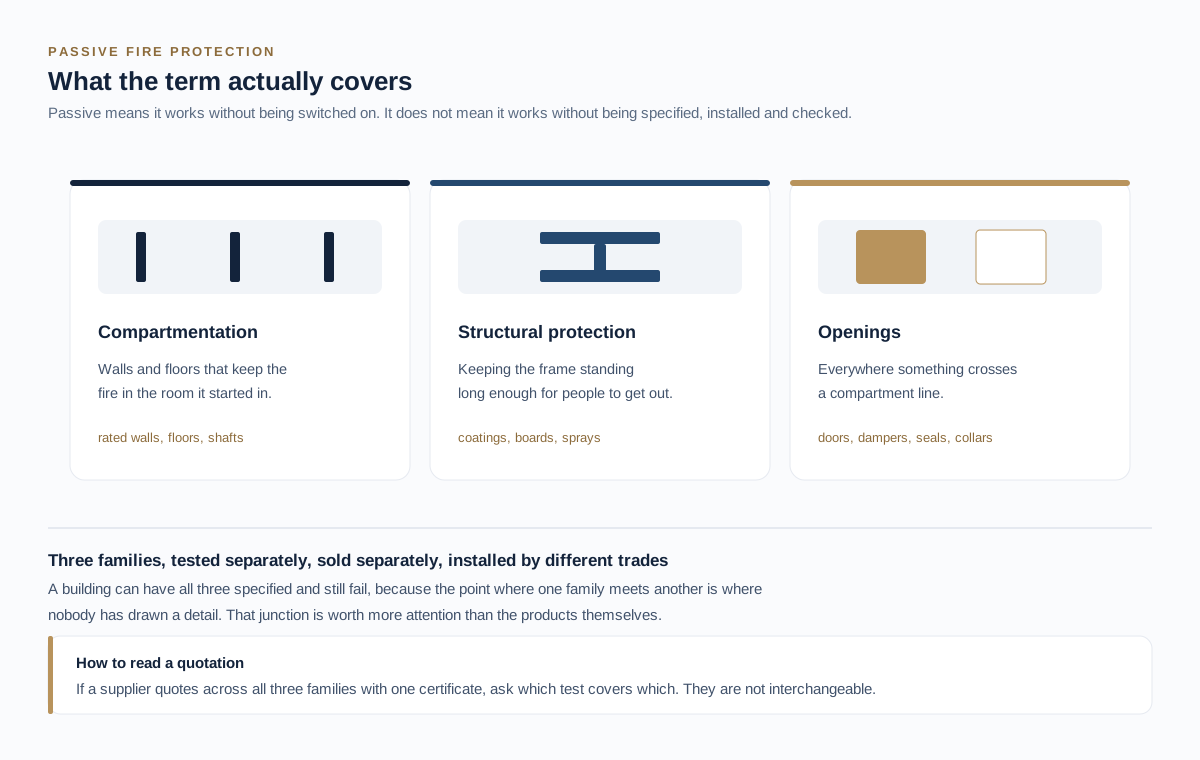
Compartmentation divides a building into boxes that fire cannot easily leave. Walls and floors form the boundaries. Doors, dampers, seals and coatings keep the boundary honest wherever something has to pass through it. Every product on this page exists because a box has holes in it.
In England, Approved Document B is the statutory guidance covering fire safety matters within and around buildings, published in two volumes, one for dwellings and one for buildings other than dwellings, in a 2019 edition carrying later amendments. It is the document that tells a designer how many minutes a given boundary needs to hold. Comparable guidance exists in Ireland, Germany and the Netherlands, and African markets often draw on British or European practice with local amendments, so we treat the destination country as part of a requirement rather than an afterthought. You can see the countries we ship into on our markets page. The number on the drawing is only half the instruction. The other half is which test regime that number was written under, and those two halves must travel together.
Passive fire protection products, and the test each family answers to
Passive fire protection products fall into a handful of families. Sealants and mortars close small gaps. Collars and wraps deal with plastic pipe. Boards and mortars protect steel and form shafts. Coatings swell to insulate structural members. Each family is proved against a different test, and mixing them up is a common source of trouble.
The families overlap less than a catalogue makes them look. A sealant that performs beautifully around a copper pipe has no answer for a 110 mm plastic waste stack, because the failure mode is different: the plastic disappears and leaves a chimney, so the product has to expand fast enough to fill the void the pipe used to occupy. A board rated for a riser shaft is likewise not automatically a substrate for anything else. Our SIMFY FIRESYS division handles these as separate technical categories rather than one shelf, because the evidence behind each differs and so do the questions a specifier asks. The table below is the short version we use when a requirement arrives with no product name attached.
| Product family | What it protects | Test regime that applies |
|---|---|---|
| Sealants and acrylic or silicone seals | Small apertures, cable and metal pipe openings, joints | EN 1366-3 for penetrations, EN 1366-4 for joints |
| Collars and pipe wraps | Plastic and composite pipe through walls and floors | EN 1366-3, or UL 1479 and ASTM E814 in US practice |
| Mortars, bricks and pillows | Large or frequently altered openings, cable trays | EN 1366-3 |
| Boards and batts | Shafts, ducts, ceiling voids, steel encasement | EN 13501-1 for reaction to fire, plus the relevant element test |
| Reactive and intumescent coatings | Structural steel beams and columns | EN 13381-8 |
| Fire doors and door hardware | Openings people walk through | EN 1634-1 |
| Ventilation duct protection | Air paths crossing a compartment boundary | EN 1366-1 |
How performance is proved
A rating is the output of a furnace test run to a defined heating curve, followed by a classification exercise. The test produces raw performance. The classification standard turns that performance into the letters and numbers a specifier writes on a drawing. Both halves are needed before a claim means anything.
BS EN 1363-1:2020 establishes the general principles for determining the fire resistance of elements of construction under standard fire exposure, and it defines the common procedures, including the temperature and time curve, that the individual test methods sit on top of. The specific method then applies: BS EN 1366-3:2009 covers penetration seals, EN 1366-4 covers linear joint seals, EN 1366-1 covers ventilation ducts, and EN 1634-1 covers door and shutter assemblies. After the furnace, BS EN 13501-2:2016 provides the procedure for classifying construction products and building elements using data from those tests. That classification standard is where E, I and EI come from. E is integrity, meaning flame and hot gas do not pass. I is insulation, meaning the unexposed face stays cool enough not to ignite what is touching it. EI 120 means both, for 120 minutes, in the arrangement that was tested.
Reaction to fire is a separate question with its own document. BS EN 13501-1:2018 classifies construction products using data from reaction to fire tests, describing how much a material itself contributes to a fire rather than how long an assembly holds one back. A board can be strong on one measure and irrelevant on the other, and buyers routinely quote one when the specification asked for the other.
The part most pages leave out: the rating belongs to a system
A fire rating is not a property of a product. It is the result achieved by one specific combination of wall or floor construction, opening size, service passing through, insulation on that service, and the product used to close the gap. Change any single element and the classification no longer describes what is on site.
This is the single most consequential thing a buyer can understand, and it is the thing catalogues are quietest about. ASTM E814 is titled Standard Test Method for Fire Tests of Penetration Firestop Systems. The word in the title is systems. UL 1479, Fire Tests of Penetration Firestops, evaluates firestops used in openings within fire-resistive wall, floor and floor-ceiling assemblies, and assigns an F rating for the time before flame appears on the unexposed surface, a T rating that adds a temperature rise criterion, an L rating for air leakage, and a W rating for resistance to water passage. Read those descriptions closely and the same logic appears: what is being rated is an opening in a defined assembly with a defined thing going through it, not a tube of mastic.
So a certificate reading EI 120 is shorthand for something much longer. It means a seal of this product, at this depth, in a dense blockwork wall of a stated thickness, around a plastic pipe of a stated diameter, in an aperture of a stated size, achieved integrity and insulation for 120 minutes. Fit the same product around a steel pipe, or in a plasterboard partition, or in a bigger hole, and the certificate describes a test that was never run. Nothing on site looks different. The paperwork simply stops matching reality, and stays that way until an inspection or a fire finds it.
Two consequences follow. A substitution is a technical change, not a commercial one, and needs evidence of its own. And the field of application matters as much as the rating: a serious report states the range of substrates, aperture sizes and service diameters the result may be applied to. Passive fire protection systems are classified as assemblies, never as tubes and boxes. So we ask which build-up a seal is going into before we ask how many units, which is the method behind how we work.
Send us the classification you need and the substrate you are sealing. We source certified product against it.
What a certificate covers, and what it does not
A declaration of performance describes a product. A test report and classification report describe a tested arrangement. A third-party certificate describes a scheme holder keeping to a scheme. None of them describes the wall in front of you, and buyers get caught by that gap more often than by anything else.
Regulation (EU) No 305/2011 requires manufacturers to draw up a declaration of performance for a product covered by a harmonised specification, and to apply the relevant marking. That document is genuine and useful, and also narrow. It states what the manufacturer declares about the product. It cannot tell you the detail on your drawing was ever tested, because the manufacturer did not draw your building. The classification report ties a number to a configuration, and is the one worth asking for by name.
Regulation has moved the same way in several markets. The Building Safety Act 2022 in the United Kingdom established a building safety regulator, placed duties on accountable persons for higher-risk buildings, and included provisions on construction products liability, reaching manufacturer accountability and cost contribution orders where products proved defective. The practical message is plain: the evidence chain behind a fire-rated product is expected to be traceable, and whoever bought it is part of that chain. We keep that trail deliberately boring, which is what our approach to trust and quality is for.
Older and newer test regimes still sit side by side
The United Kingdom used the BS 476 series for decades before the European tests arrived. Both appear on real projects and in real product literature. A number quoted under one regime is not automatically interchangeable with the same number under the other, and older specifications often still name the older tests.
BS 476-20:1987 sets out the method for determining the fire resistance of elements of construction and the general principles behind that older family of tests. Recent amendments to the English statutory guidance have moved away from those national classes towards BS EN 13501 for a number of applications, which is why refurbishment work in particular throws up specifications written to one regime and products certified to another. Neither situation is wrong on its own. The mistake is assuming an equivalence that nobody has demonstrated. When a requirement reaches us naming a BS 476 rating, we say so and ask which evidence route the approving authority will accept, rather than quietly supplying the nearest European equivalent and letting the difference surface later.
Buying across markets without losing the classification
European, British and American test regimes measure similar things in different ways and issue different labels. A product listed under one regime is not automatically acceptable under another. The destination market, and the authority that will inspect the job, should be decided before an order is placed.
An F rating and an EI classification are not translations of each other. They come from different methods with different criteria, and an approving authority in Nairobi, Berlin or Dublin will have its own view of which evidence it accepts. Several African markets recognise British or European practice, sometimes alongside product listings issued elsewhere, and the answer varies by project and by client. That is solvable, but only early, because a container of correctly made product carrying the wrong evidence is still the wrong delivery. So the first question on any enquiry is where the goods are going and who signs the job off, before anything about quantity or product name.
Where we fit, and where we do not
Simfy Exim supplies and sources product. We do not install, and we are not a contractor. If you need a seal fitted, inspected and signed off on site, you need an installer, and we will say so rather than take the order.
Our part happens before anyone is on site. We take a requirement, identify products whose manufacturers hold the test evidence the specification calls for, verify the supplier, and can arrange factory audit and pre-shipment inspection so what leaves the factory matches what was quoted. We hold no third-party certification ourselves and claim none. The certificates belong to the manufacturers whose product we supply, which is a different statement and an honest one.
We are a poor fit for three situations. A single item at short notice is better served by a local distributor. A fire strategy or a detail design is a fire engineer’s work, not ours. And if the paperwork needs to be flexible, the answer will be no. If none of those apply, send us the requirement with substrate, aperture and service details, and you will get a specific answer rather than a catalogue.
Is passive fire protection a legal requirement?
Building regulations in most of our markets require construction works to resist fire spread and maintain stability for a period, and compartment boundaries are how that is achieved. In England, Approved Document B is the statutory guidance covering fire safety matters within and around buildings. The specific minutes required depend on building type, height and use.
What is the difference between E 60 and EI 60?
EN 13501-2 defines E as integrity, meaning flame and hot gas do not pass through, and I as insulation, meaning the unexposed surface stays below defined temperature limits. E 60 holds flame back for 60 minutes but the cold face may get hot enough to ignite material touching it. EI 60 does both.
Will a product with a valid certificate pass inspection?
Not by itself. An inspector looks at what is installed against what was specified and what was tested. A genuine certificate for a configuration different from the one on site does not help. Ask for the classification report and check its field of application against the actual substrate, opening size and service.
What happens if the opening on site is bigger than the tested one?
The classification stops applying. A test report states the range of aperture sizes the result covers, and an opening outside that range has no evidence behind it. The options are a different tested arrangement, a manufacturer assessment covering the variation, or making the opening match the tested detail.
Can a UL-listed firestop be used on a European project?
Only if the approving authority accepts that evidence. UL 1479 and EN 1366-3 are different methods with different pass criteria and different labels, so an F rating is not a conversion of an EI classification. Decide the acceptable evidence route before ordering, not after the container lands.
How can I tell whether a test certificate is genuine?
Check that it names an accredited laboratory, carries a report number and date, states the exact tested configuration, and gives a field of application. Certification bodies and laboratories will confirm a report number on request. A document that gives a rating with no configuration behind it is marketing, not evidence.
Do fire-rated boards need a reaction to fire class as well?
Often yes, and it is a separate document. EN 13501-1 classifies products using reaction to fire test data, describing how the material itself behaves in a fire, while the fire resistance classification standard covers how long an assembly holds one back. A specification may call for both, and they are not interchangeable.
Does Simfy Exim install what it supplies?
No. We supply and source product, verify suppliers, and can arrange factory audit and pre-shipment inspection. Installation, site inspection and sign-off are a contractor’s responsibility, and any seal must be fitted in line with the manufacturer’s tested detail for the classification to stand.
BS EN 13501-1:2018, fire classification using data from reaction to fire tests
BS EN 1363-1:2020, fire resistance tests, general requirements
BS EN 1366-3:2009, fire resistance tests for service installations, penetration seals
BS EN 1366-4, fire resistance tests for service installations, linear joint seals
BS EN 1366-1, fire resistance tests for service installations, ventilation ducts
BS EN 1634-1, fire resistance test for door and shutter assemblies and openable windows
BS EN 13381-8:2010, applied reactive protection to steel members
BS 476-20:1987, determination of the fire resistance of elements of construction
BS 7974:2019, application of fire safety engineering principles to the design of buildings
UL 1479, Fire Tests of Penetration Firestops, and its F, T, L and W ratings
ASTM E814, Standard Test Method for Fire Tests of Penetration Firestop Systems
Regulation (EU) No 305/2011, the Construction Products Regulation
Building Safety Act 2022, United Kingdom
Approved Document B, fire safety, statutory guidance for England
Supplier verification, factory audit and pre-shipment inspection are part of how we buy, not an extra.