FOB vs CIF vs DDP: Which Incoterm Protects You?
Buying from overseas? FOB vs CIF vs DDP explained: where risk really transfers, why FOB fails for containers, and when DDP is not legally available at all.
- What do FOB, CIF and DDP actually mean?
- Why risk and cost do not move at the same point
- Why FOB and CIF are the wrong tools for a container
- The DDP trap: it is not always legally available
- Who really pays demurrage and detention?
- CIF and CIP do not insure you equally
- What the Incoterm does not decide
- How to choose the term for your next order
- Where a sourcing partner changes the answer
The container landed on a Tuesday. By Friday the buyer had a bill for storage he had never agreed to, from a terminal he had never dealt with, for a delay caused by a document his supplier was supposed to send. His contract said CIF. He had read that as “the seller handles it all the way to my port”. It does not say that. It never did.
Three letters at the bottom of a quotation decide who carries the loss when a crate is dropped, who argues with customs, and who pays when a box sits too long at a terminal. Most buyers pick a term because a supplier offered it, or because the landed number looked cleanest. That is how exposure gets bought by accident.
This guide sets out what FOB, CIF and DDP actually do, where each one leaves a gap, and the two mistakes that cost buyers the most money. At Simfy Exim we source building products for buyers in the USA and Europe on an open-book basis, which means the Incoterm is a decision we make with the buyer rather than one that arrives pre-selected on a supplier’s pro forma.
What do FOB, CIF and DDP actually mean?
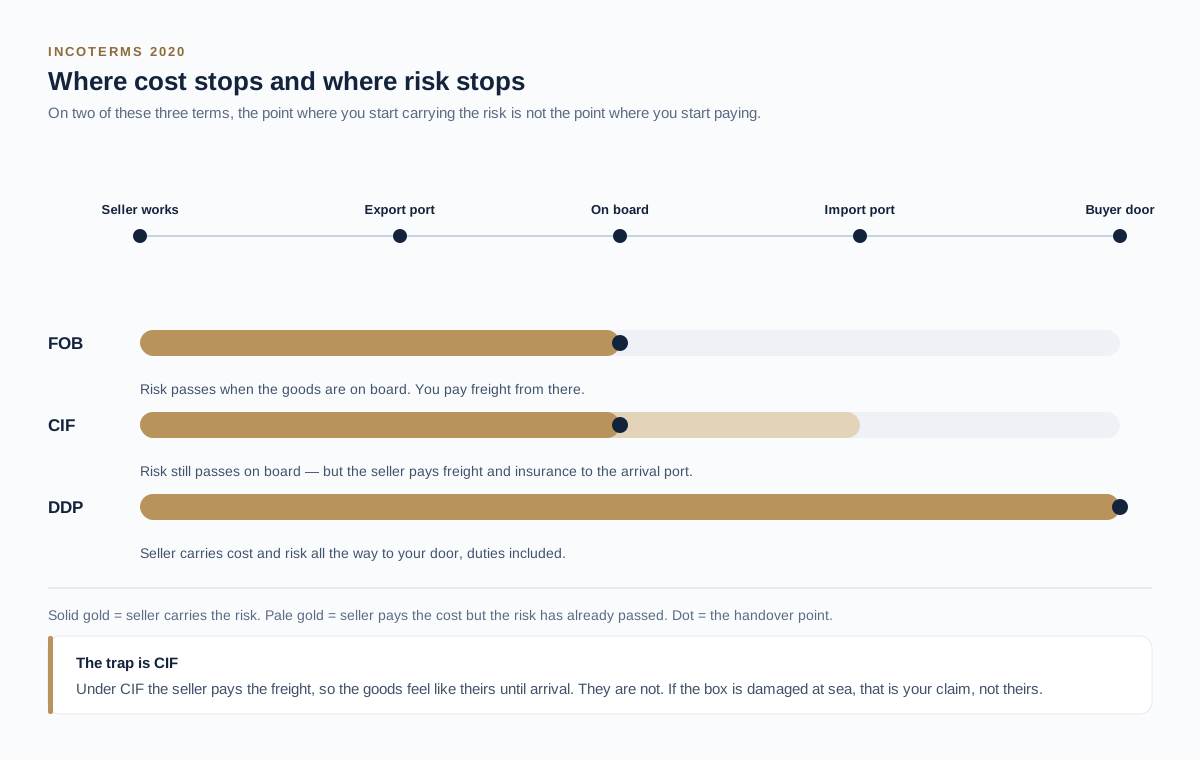
FOB means the seller gets the goods onto the ship and stops there. CIF is the same, except the seller also books and pays for the sea freight and a basic insurance to your port. DDP means the seller brings it all the way to your door, customs cleared and duty paid. The catch is that cost and risk do not always move at the same moment. That gap is where buyers lose money.
All three come from the same rulebook. The International Chamber of Commerce publishes the Incoterms rules, and the current edition is Incoterms 2020. The ICC describes them as a set of eleven three-letter trade terms that give a clear allocation of cost, risk and obligations between seller and buyer. That list is deliberately narrow. The rules say who does what and who pays for it. They do not set your price, they do not set your payment terms, and they do not transfer ownership of the goods. If your contract is silent on title, the Incoterm will not fill the gap for you.
The ICC splits the eleven rules into two families. Six rules work for any mode of transport, including FCA, CPT, CIP, DAP, DPU and DDP. Two rules, FOB and CIF, sit in a separate group that the ICC lists under rules for sea and inland waterway transport. That split matters more than most quotations acknowledge, and the next section explains why.
| Question | FOB | CIF | DDP |
|---|---|---|---|
| Where risk passes to the buyer | On board the vessel, origin port | On board the vessel, origin port | At the named destination, ready for unloading |
| Who books and pays main carriage | Buyer | Seller | Seller |
| Who insures the sea leg | Buyer (if at all) | Seller, minimum cover | Seller’s commercial choice |
| Who clears import and pays duty | Buyer | Buyer | Seller |
| Suitable for containers | No — see below | No — see below | Yes |
Why risk and cost do not move at the same point
Under CIF the seller pays the freight and the insurance to your port. But the risk became yours the moment the goods were loaded at the other end. The seller’s money keeps travelling long after your risk has already started. Reading “seller pays to my port” as “seller is responsible to my port” is the single most expensive misreading in the C-rules.
The ICC Academy states plainly that in the C-rules, cost and risk transfer at different stages, with the seller arranging and paying for transport to the named destination but the risk for that transport borne by the buyer. It gives CIF as its own example: the place of delivery is when the goods are placed on board the vessel at the port of shipment, and risk also transfers there, yet the seller still pays freight and insurance onward to a named destination port. The same guidance warns that the place of transfer of risk and the destination of the goods under the sale contract are not always identical, and advises parties to set out the circumstances of the passage of risk very carefully in the sale contract rather than assuming the two points coincide.
Work through what that means on a real shipment. A container of steel doorsets is loaded at origin under CIF. Mid-ocean the vessel meets heavy weather and part of the consignment is damaged. The seller has done everything the rule asks of him. The loss is the buyer’s, and the buyer’s remedy is the insurance policy the seller bought — a policy the ICC only requires to be minimum cover under CIF. If that cover does not answer the loss, the buyer absorbs it. This is not a defect in CIF. It is what CIF is, and it is why a buyer who has never read the rule ends up feeling cheated by a supplier who has done nothing wrong.
Why FOB and CIF are the wrong tools for a container
FOB and CIF were written for goods loaded directly onto a ship. A container is handed to a terminal days before it is loaded. Between the gate and the crane the goods sit in a place where the seller no longer controls them and the buyer’s risk has not yet started. For containerised cargo the ICC recommends FCA instead.
The ICC Academy notes that FOB is one of the oldest terms, originating in the early 1800s when ocean shipments were the primary route for international trade and containers did not yet exist. Under FOB, the same guidance confirms, risk transfers once the goods are loaded on board the vessel at the named port of shipment. Under FCA risk transfers when the seller has delivered the goods to the carrier. The ICC recommends FCA as the appropriate rule when goods are transported in containers or pallets and multiple modes of transport are used.
The practical consequence is a hole in the middle of a very common arrangement. Your supplier delivers a sealed container to the port terminal on Monday. The vessel loads on Thursday. Under a strict reading of FOB, the seller carries risk for those three days even though the box has left his control entirely, and neither party’s insurance is usually written to sit cleanly in that window. Terminal fires and stack collapses are rare. They are not hypothetical, and a claim in that window is exactly where a cheap term becomes an expensive one. If your goods move in a container — and most building products do — FCA is the honest answer, and it is worth asking a supplier who insists on FOB whether he knows why he is insisting.
The DDP trap: it is not always legally available
DDP asks the seller to clear the goods for import and pay the duty in the buyer’s country. In some destinations the local rules do not allow a foreign seller to do that at all. Where the law requires the local party to be importer of record, DDP cannot be used, and DAP is the correct rule instead.
This is the point almost every DDP explainer skips, and it is the one that strands shipments. The ICC Academy is direct about it. It advises that if the seller does not want to manage import clearance, or is prevented by local rules in the destination country from doing so, then DAP is a more suitable Incoterms rule. It goes further: some import customs authorities impose legal restrictions or regulations that require the local importer — the buyer — to carry out the import clearance themselves, and in such cases DDP cannot be used, and DAP would be appropriate.
Read a DDP quotation with that in mind and the questions change. The right question is no longer “is DDP cheaper than the alternative”. It is whether the seller can lawfully act as importer of record where your goods are landing, whether he holds the registration to do it, and what happens to your container if he cannot. A DDP price from a supplier who has never imported into your market before is a promise about a process he has not tested. DAP gives you the same door-to-door carriage with import clearance left where the law usually expects it — with you.
| Situation | Reach for | Why |
|---|---|---|
| Containerised goods, buyer has a freight forwarder | FCA | Risk transfers at handover, not at a crane you cannot see |
| Buyer wants seller to arrange freight but keep control of insurance | CPT | C-rule carriage without relying on minimum cover |
| Buyer wants door delivery, is happy to clear import | DAP | Works everywhere; no importer-of-record problem |
| Buyer wants a single landed number and seller can lawfully import | DDP | Only when the seller is registered in the destination |
| Break-bulk or project cargo loaded directly to a vessel | FOB or CIF | The cargo type these rules were actually written for |
Who really pays demurrage and detention?
Demurrage is charged when a container sits in a terminal past its free days. Detention is charged when a container leaves the terminal and is not returned in time. Whatever the Incoterm says, the carrier bills the consignee first. Recovering it from the party who caused the delay is a separate argument you have to win.
Incoterms Explained defines demurrage as charges for containers kept in a terminal for longer than the allowed number of free days, and detention as charges for containers that, once outside the terminal, have not been returned within the allowed time. The same source records that demurrage and detention charges will always be addressed to the consignee in the first instance, and that it is then up to the consignee to argue the matter with their counterparty.
That sequence is what buyers miss. The Incoterm allocates responsibility between you and your seller. It does not tell the shipping line who to invoice. If a certificate arrives late and your box misses its free days, the bill lands on you first, and your only route back is the sale contract. The practical protection is not a different three-letter code. It is a documentary deadline written into the purchase order — every certificate, packing list and bill of lading in your hands a fixed number of days before arrival, with a named consequence if they are not. A buyer who specifies documents the way a good tender specifies a fire-stopping system rarely pays demurrage twice.
We quote open-book, so freight, duty and margin sit on separate lines and the Incoterm becomes a risk decision.
CIF and CIP do not insure you equally
Two of the eleven rules oblige the seller to buy insurance. Most buyers read that as one thing. It is not.
The ICC states that under Incoterms® 2020, CIP now requires cover compliant with Institute Cargo Clauses (A) — the widest of the standard cargo covers — while Institute Cargo Clauses (C) remains the default under CIF, which is a named-perils cover and much narrower. Same word on the quotation, different protection behind it.
The practical consequence: on a CIF container you may be insured against the ship sinking and not against the crate being crushed. If the cargo is high value or damage-sensitive, either agree a higher level of cover in the contract or buy your own policy and stop paying the seller for one you cannot rely on.
Source: ICC — Incoterms® 2020. Note that DPU replaced the former DAT rule in the 2020 revision.
What the Incoterm does not decide
An Incoterm allocates cost, risk and obligation. It does not set your price, your payment terms, your inspection rights, your remedy for defective goods, or the moment ownership passes. Every one of those has to be written somewhere else in the contract, and a quotation that names only a term has left them all open.
This is where a sourcing contract earns its keep. The three letters answer a narrow question well and stay silent on everything around it. A purchase order that says only “CIF Rotterdam” tells you where risk moves and nothing about what happens if the goods arrive to the wrong specification, who inspects before shipment, or when title passes for the purposes of your own financing. Those are separate clauses, and they are the ones that decide whether a bad shipment is recoverable.
The habit worth building is to treat the Incoterm as one line in a specification rather than as the specification. Alongside it, name the inspection regime, the documents and their deadlines, the tolerance for short shipment, and the standard the goods must meet. For technical products that last part carries most of the weight — a certificate has to cover the product you are actually buying, which is the same discipline that decides whether a passive fire protection product is fit for the wall it goes into.
How to choose the term for your next order
Work backwards from three questions: can you or your agent clear customs where the goods land, do you have freight rates worth using, and where do you want risk to start? Answer those honestly and the term picks itself. Choosing by landed price alone is how buyers end up owning risk they never priced.
Start with control. If you have a forwarder you trust and rates you have negotiated, an F-rule keeps the carriage in your hands and the margin out of the seller’s freight line. If you do not, a C-rule or D-rule buys convenience, and you pay for it somewhere. Neither is wrong. What is wrong is buying convenience while believing you have bought protection.
Then look at mode. Containers point to FCA. Direct vessel loading of break-bulk points to FOB or CIF. Then look at clearance. If you can be importer of record, DAP delivers to your door without the DDP registration problem. Finally look at insurance. Under CIF you are relying on cover the seller chose to a minimum standard; if your consignment is high-value or fragile, buy your own policy on top rather than assuming the gap is not there.
One more discipline is worth the effort. Name the place precisely. “FCA” alone means very little; “FCA Nhava Sheva CFS, Incoterms 2020” means something you can enforce. The ICC rules are written around a named place, and a term without one is an argument waiting to happen.
Where a sourcing partner changes the answer
A sourcing partner working open-book shows you the freight, the duty and the margin as separate lines, so the Incoterm becomes a decision about risk rather than a way of hiding cost inside a single delivered price. That is the difference between a landed number and a landed number you can audit.
Simfy Exim works on a requirement-led basis for buyers in the USA and Europe, with supplier verification, factory audit and pre-shipment inspection available as separate steps rather than assumed. Our sourcing network spans India, China, Turkey, Malaysia, Vietnam and Europe, and we keep origin and destination clearly separated in every quotation because they answer different questions. We supply; we do not install, and we do not hold local stock unless a contract says so.
What that means in practice for the Incoterm decision is simple. On an open-book quotation you can see what the freight actually costs, so a D-rule stops being a black box. You can see whether the duty assumption is right for your tariff code. And when the honest answer is that DDP is not available into your market, you hear it before the container ships rather than after. If you are weighing a delivered price against an FCA price on a real order, bring us the specification and we will show you both, line by line.
What is the main difference between FOB and CIF?
Under both rules risk passes to the buyer when the goods are on board the vessel at the origin port. The difference is cost: under CIF the seller also books and pays the sea freight and a minimum insurance to the named destination port. CIF is not more protective than FOB — it is the same risk position with the freight prepaid.
Is DDP always the safest option for a buyer?
No. DDP requires the seller to clear the goods for import and pay duty in the buyer’s country, and ICC guidance is explicit that some customs authorities require the local party to carry out import clearance themselves, in which case DDP cannot be used and DAP is appropriate. Check that the seller can lawfully act as importer of record before you accept a DDP price.
Which Incoterm should I use for a container shipment?
FCA. The ICC recommends FCA when goods move in containers or on pallets and more than one mode of transport is involved. FOB and CIF were written for goods loaded directly onto a vessel and leave a gap between terminal handover and loading where neither party’s cover sits cleanly.
Do Incoterms decide when ownership of the goods passes?
No. The Incoterms rules allocate cost, risk and obligations between seller and buyer. Transfer of title is not covered and must be dealt with separately in the sale contract, along with price, payment terms and remedies for defective goods.
Who pays demurrage if the delay was the supplier’s fault?
The carrier bills the consignee first, regardless of the Incoterm. You then have to recover it from the party who caused the delay under your sale contract. The practical protection is a documentary deadline in the purchase order rather than a different Incoterm.
What does the insurance under CIF actually cover?
CIF obliges the seller to take out cover to a minimum standard only. For high-value, fragile or long-lead goods that minimum may not answer a real loss. If the consignment matters, buy your own policy on top or use CIP, where the required level of cover is higher.
Can I change the Incoterm after the order is placed?
Only by agreement, and it is rarely a clean swap. Changing from CIF to FCA mid-order usually means renegotiating the price, the delivery point and often the payment terms, because the seller has priced freight into the original figure. Settle the term before the pro forma is signed.
How should the Incoterm be written on a purchase order?
Always with a named place and the edition. “FCA Nhava Sheva CFS, Incoterms 2020” is enforceable; “FCA” alone is not, because the rules are built around a named place. Adding the edition avoids any argument about which version of the rules applies.
Check the seller can lawfully act as importer of record where your goods land. We will tell you before the container ships.