How to Verify a Supplier Before You Place an Order
About to pay a new supplier? How to verify a supplier properly: the registration check, what a factory audit sees, and the statistical limit of inspection.
- What does supplier verification actually prove?
- Step one: prove the entity before anything else
- Factory or trading company, and why it matters
- What a factory audit sees that a video call cannot
- The limit of pre-shipment inspection nobody explains
- Reading a certificate properly
- The documents India actually requires
- Building the checks into the order, not around it
- When to verify yourself and when to buy the check
The factory photos were real. The business licence was real. The certificate was real. Every single document checked out, and the shipment still arrived wrong — because the licence belonged to a trading company, the photos were of a factory that had quoted the job, and the certificate covered a product two grades below the one on the purchase order. Nothing was forged. The buyer just never asked what each document was actually for.
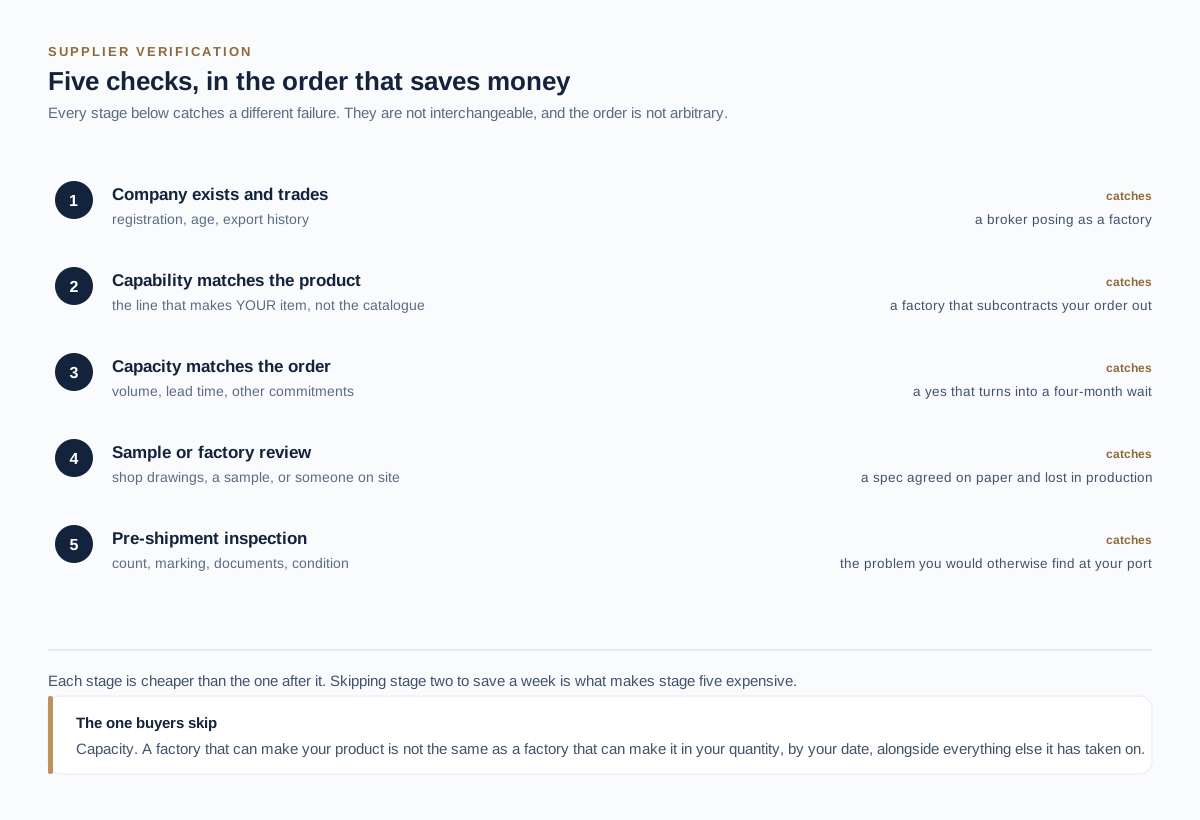
Verifying a supplier is not a background check. It is a set of specific questions, asked in a specific order, where each answer narrows what can still go wrong. Skip one and the others stop meaning much.
This guide sets out the checks that catch a bad supplier before money moves, what a factory audit sees that a video call cannot, and the hard statistical limit of pre-shipment inspection that almost nobody explains to buyers. Simfy Exim runs supplier verification, factory audit and pre-shipment inspection as separate steps for buyers in the USA and Europe, and this is the sequence we work through.
What does supplier verification actually prove?
Verification proves that a real company exists, that it is allowed to do what it says it does, and that it controls the factory making your goods. It does not prove the goods will be right. Those are two different problems. Buyers who treat them as one stop checking after the first.
Think of it as three separate questions with three separate answers. Does this company exist and can it legally export? Does it make the thing, or does it buy the thing? Will the goods that ship match the goods that were approved? A registration search answers the first. A factory audit answers the second. Inspection answers part of the third and is honest about the part it cannot answer.
Most disputes start because a buyer got a good answer to question one and treated it as an answer to all three. A valid business licence tells you the company is real. It tells you nothing at all about whether the sealed container leaving the yard contains the product you specified.
| Check | Answers | Does not answer |
|---|---|---|
| Registration and export licence | Does this entity exist and can it export | Whether it manufactures anything |
| Factory audit | Does it own the process and equipment | Whether this order gets that process |
| Sample approval | Can it make one good unit | Whether it can repeat it at volume |
| Pre-shipment inspection | Does the sampled portion conform | The condition of every unit in the lot |
| Certificate review | That a tested product exists | That your product is that product |
Step one: prove the entity before anything else
Get the registered company name in the local language, the registration number, the registered address, and what the company is licensed to trade in. Then check that the name on the bank details is the same name as on the licence. If they do not match, that is not untidy paperwork. It is the most common way a payment leaves and no goods ever arrive.
The scope of business line is the one to read carefully. A registration states what the entity is permitted to do, and the difference between a scope that includes manufacturing and one that covers only wholesale, import and export is the difference between a factory and a middleman. That single line settles in thirty seconds a question a supplier will otherwise answer with photographs, a factory tour video and three days of email.
Collect five things before the first payment: the registered name in the local language and in English, the registration or company number, the registered address, the scope of business, and the export licence or equivalent registration. Then match all five against the pro forma invoice, the bank details and the name on any test report. Documents that disagree with each other are the signal; documents that look impressive on their own are not.
Two practical rules save more money than any document. First, never pay an account in a different name from the one on the contract, and never accept a late banking change by email — that pattern is the mechanics of an interception, not an accounting update. Confirm any change by voice on a number you already held, not on the number in the message. Second, ask for the export registration separately: in India that is the Importer Exporter Code issued by the DGFT, in China the customs registration certificate, and in Turkey membership of the relevant exporters’ association. Domestic manufacturing rights and export rights are not the same permission, and a plant that has never exported is a different risk from one that ships weekly.
Factory or trading company, and why it matters
A trading company is not a fraud. It is a margin and a layer of distance. The problem is not that it exists, it is that a trading company presented as a factory means you cannot control the process, cannot audit the line, and often cannot find out who actually made your goods when something fails.
The tells are consistent. A real factory quotes narrowly and well within its own capability, and gets vague or expensive outside it. A trading company quotes almost anything. Ask for a product outside the stated range and watch which happens. Ask about a process detail — the cure schedule, the tolerance on a section, the treatment before coating — and a factory answers immediately because someone in the room runs it.
Then check the documents against each other. The name on the business licence, the name on the test report, the name on the export declaration and the name on the invoice should form a coherent picture. Where they do not, the gap is worth a direct question rather than an assumption. It is entirely reasonable to work through a trading company on a small order; it is not reasonable to do so without knowing you are.
What a factory audit sees that a video call cannot
An audit checks the things that only exist physically: the equipment on the floor, the calibration records, the incoming material control, the reject bin. A video call shows you a curated corridor. The gap between those two is where most quality failures are born.
The most useful part of an audit is rarely the production line. It is the paperwork around it. Are incoming raw materials tested on arrival or accepted on a supplier’s word? Is the testing equipment calibrated, by whom, and are the calibration certificates current rather than expired last year? Is there a documented route for a failed batch, and is there evidence in the records that it has ever been used? A factory with no record of ever rejecting anything is not a factory with no defects. It is a factory with no record.
Ask for three specific documents on the day: the calibration register, the last six months of incoming inspection records, and the non-conformance log. Those three describe the quality system as it actually runs rather than as a manual describes it. A supplier who can produce all three within the hour is telling you something no certificate can.
Capacity is the other thing an audit settles. A line that runs at a given rate cannot deliver three times that rate because an order requires it. When a supplier accepts a lead time that his floor cannot support, the shortfall gets made up by subcontracting to a plant you have never seen and never approved. That is how a consignment arrives with two different finishes in the same container.
The limit of pre-shipment inspection nobody explains
A passed inspection is a statistical statement, not a guarantee. Sampling checks a fraction of the lot and accepts or rejects the whole on that evidence. A shipment materially worse than your stated quality limit can still pass, and the numbers behind that are published, not hidden.
Sampling inspection runs to a published standard. ISO 2859-1 sets out sampling schemes indexed by acceptance quality limit for lot-by-lot inspection, and ANSI/ASQ Z1.4 covers the same ground in North American practice. Both work the same way: the lot size and the inspection level fix a sample size, and the acceptance quality limit fixes how many defects that sample may contain before the whole lot is rejected. Nothing in either document promises that an accepted lot is defect-free.
The arithmetic is worth stating plainly, because most inspection reports do not. ICW gives a worked example of 125 pieces drawn from a lot of 3,000, which puts a little over four per cent of the shipment under a lens and applies the verdict to all of it. Against a 2.5 per cent requirement, ICW records that a good lot at 2.33 per cent defective still carries one chance in a hundred of rejection, and that a bad lot at 6.14 per cent defective carries fifty chances in a hundred of acceptance. A shipment two and a half times worse than your stated limit is a coin flip away from passing.
Two habits close most of that gap. Raise the inspection level rather than loosen the AQL when the consequence of a defect is high, because a larger sample moves the curve where adjusting the limit alone does not. And split defect classes in the purchase order: a critical defect that makes the product unusable should carry an acceptance number of zero, whatever the major and minor limits are set to.
| Lot size | Level II code | Sample size | Accept at AQL 2.5 | Reject at AQL 2.5 |
|---|---|---|---|---|
| 501 to 1,200 | J | 80 | 5 | 6 |
| 1,201 to 3,200 | K | 125 | 7 | 8 |
| 3,201 to 10,000 | L | 200 | 10 | 11 |
General inspection level II, single sampling, normal inspection. Tetra Inspection lists these code letters and sample sizes, and records Ac 5 / Re 6 at sample 80 and Ac 7 / Re 8 at sample 125 for AQL 2.5; QIMA states that code letter L at AQL 2.5 takes a sample of 200 and passes at 10 or fewer failures. Read your own lot size off the table before you agree an AQL.
None of that makes inspection worthless. It makes it one control among several. The buyers who get burned are the ones who treat a passing report as a warranty and stop specifying anything else. The buyers who do well use inspection to catch systematic failure — the wrong material, the wrong dimension, the wrong marking across the board — and use the contract to handle the rest.
| Failure mode | What catches it | What misses it |
|---|---|---|
| Trading company posing as a factory | Registration scope, audit | Photos, video call, samples |
| Certificate for a different product | Reading the certificate scope | Confirming the certificate is genuine |
| Sample-to-production drift | Retained sample plus inspection | Sample approval alone |
| Undeclared subcontracting | Capacity check during audit | Lead-time promises |
| Scattered low-rate defects | Nothing reliably — see above | Sampling inspection |
Send us the specification and the suppliers. We will tell you honestly which checks are worth buying and which are not.
Reading a certificate properly
The question is never whether the certificate is genuine. It is whether the certificate covers the product you are buying, in the configuration you are buying it, and whether it is still valid. Most certificate problems are scope problems, not forgeries.
A test report describes a specific tested article. Change the substrate, the thickness, the dimension or the supporting construction and you may be outside what was tested. For technical building products this is the whole game — a rating belongs to a tested system rather than to a product in a box, which is the same principle that decides whether a fire-stopping seal performs in the wall it is actually installed in. Ask for the scope page, not the summary page, and read what was tested rather than what the cover claims.
Then check dates and issuer. A lapsed certificate is not evidence of current production. A certificate issued to a different legal entity in the same group is not evidence about your supplier. Where a product family is broad, ask which specific reference in the report corresponds to the item on your order, and get that in writing before production starts rather than after a rejection.
The documents India actually requires
There is a difference between the documents customs requires and the wider set your bank and your own customs authority will want. Both matter, for different reasons.
Mandatory for export clearance from India, per the Foreign Trade Policy as set out in the official customs import-export procedures:
- Bill of Lading or Airway Bill
- Commercial invoice cum packing list
- Shipping Bill or Bill of Export
That is a short list, and deliberately so — India reduced the mandatory set some years ago. The longer list appears when documents go to a bank for payment:
| Document | What it actually evidences |
|---|---|
| Proforma invoice | What you agreed to buy, at what price, on what terms. The reference point for every later dispute |
| Commercial invoice cum packing list | What was actually shipped and billed. Compare it to the proforma, line by line |
| Bill of Lading / Airway Bill | That the carrier received the goods, and who controls their release |
| Shipping Bill / Bill of Export | The customs declaration on the Indian side |
| Certificate of Origin / GSP | Where the goods were made — which can change the duty you pay at your end |
| Inspection certificate | That a stated property was measured. Check who measured it and against which standard |
| Bill of exchange / Letter of Credit | The payment instrument, where one is used |
| Declaration under Foreign Exchange | The exporter’s undertaking on realising payment, under Indian FEMA rules |
The one buyers skim is the certificate of origin, and it is the one most likely to change your landed cost.
Source: DGFT — Customs Import Export Procedures
Building the checks into the order, not around it
Verification only holds if it is written into the purchase order. A retained approved sample, a named inspection stage with a defined consequence, a documentary deadline and an explicit no-subcontracting clause turn checks into rights. Without them you have opinions, and opinions do not stop a container.
Four clauses do most of the work. Keep a sealed, signed retained sample with both parties so that “this is not what we approved” is a comparison rather than an argument. Name the inspection stage and say what happens on failure — rework at the supplier’s cost, re-inspection at the supplier’s cost, and who decides. Set a documentary deadline so certificates and shipping documents arrive before the goods do. And require written approval before any part of the order is subcontracted.
The same discipline that makes a technical specification enforceable makes a supply contract enforceable: describe the performance you need and the evidence you will accept, rather than naming a brand and hoping. That is exactly how a well-written tender handles substitution and evidence, and the logic travels.
When to verify yourself and when to buy the check
Verify yourself when the order is small, the product is simple and a failure is recoverable. Buy the check when the value is high, the product is technical, the lead time leaves no room to remake, or the failure would land on a project rather than a warehouse.
The economics are usually straightforward. A registration search and a careful document review cost time and no money. A physical audit and an inspection cost money and are cheap against a container that has to be scrapped or a project that stops. What decides it is not order value alone but consequence: a low-value item on the critical path of a building can be far more expensive to get wrong than a high-value item sitting in stock.
Simfy Exim works requirement-led and open-book, so verification, factory audit and pre-shipment inspection appear as separate line items you can choose rather than as a bundled promise. Our network covers India, China, Turkey, Malaysia, Vietnam and Europe, and we keep sourcing origin and buyer market clearly separated in every quotation because they answer different questions. We supply and we verify; we do not manufacture, and we do not certify. If you have a specification and a shortlist of suppliers you are unsure about, send us both and we will tell you honestly which checks are worth buying.
How do I check if a supplier is a real factory?
Read the scope of business on the company registration: it states whether the entity is permitted to manufacture or only to trade. Then test the quote — a factory prices narrowly within its own capability and answers process questions immediately, while a trading company quotes almost anything and gets vague on detail. A physical audit settles it.
Is a business licence enough to verify a supplier?
No. A valid licence proves the entity exists and states what it is permitted to do. It says nothing about production capability, capacity, quality control or whether your specific order will be made in-house. Treat it as the first of several checks rather than the only one.
Does a passed pre-shipment inspection guarantee the goods are good?
No. Sampling inspection under ISO 2859-1 or ANSI/ASQ Z1.4 examines a fraction of the lot and applies the decision to the whole. A published worked example shows a lot at 6.14 per cent defective still has a 50 per cent chance of passing against a 2.5 per cent requirement. Inspection catches systematic failure reliably; scattered defects it may miss.
What is the most common way buyers lose money on a first order?
Paying an account in a name that does not match the contracting entity, usually after a late banking change sent by email. Verify bank details against the registration and confirm any change by a separate channel, never by replying to the message that requested it.
What should a factory audit actually look at?
Equipment and calibration records, incoming material control, evidence that failed batches have genuinely been rejected, and real capacity against your lead time. A supplier accepting a schedule his floor cannot support will subcontract, and undeclared subcontracting is how one container arrives with two different finishes.
How do I stop a supplier substituting a cheaper material?
Keep a sealed retained sample signed by both parties, specify the material by standard rather than by brand, name the inspection stage in the purchase order and state the consequence of failure. Without a retained sample, a substitution argument becomes one description against another.
My supplier sent a test certificate. What should I check on it?
The scope page, not the cover. Confirm the tested article matches your product in substrate, thickness, dimension and supporting construction, that the certificate is current, and that it was issued to your actual supplier rather than a related company. Scope mismatches are far more common than forgeries.
Can I rely on a supplier’s own quality report?
Only as a starting point. A supplier’s report tells you what the supplier measured and chose to report. Where the consequence of failure is significant, use an independent inspection with a defined sampling standard and a written consequence for a failed lot, so the report is evidence you can act on.
Supplier verification, factory audit and pre-shipment inspection are line items you choose, not a bundled promise.