STS Prepaid Meters and the TID Rollover Explained
Buying STS prepaid meters for an estate or utility? What the TID rollover did, why the base date matters at order stage, and what to settle before manufacture.
In simple words
A prepaid meter is topped up with a 20-digit token. Every token carries a number, and that number is counted from a fixed start date built into the meter.
- Meters left on the old 1993 start date stop accepting credit tokens.
- Meters on the new 2014 start date keep working to 2045.
- Every meter is also locked to one supply group at the factory, so it only accepts tokens generated for that group.
So before you raise the purchase order, confirm two things in writing: which start date the batch is built on, and that the vending system you intend to use can generate tokens for your supply group. Get either one wrong and you receive meters whose tokens will not load.
- What is STS and who controls it?
- What is the TID and why did it run out?
- What was the deadline, and what happens to a meter that missed it?
- How big was the affected population?
- How is a meter actually updated?
- What should a buyer check before ordering STS meters?
- Prepaid or postpaid: which suits an estate?
- Where does the water side fit?
- How accurate does a water meter have to be?
- What sits behind the meter?
- Does the origin of the meter matter?
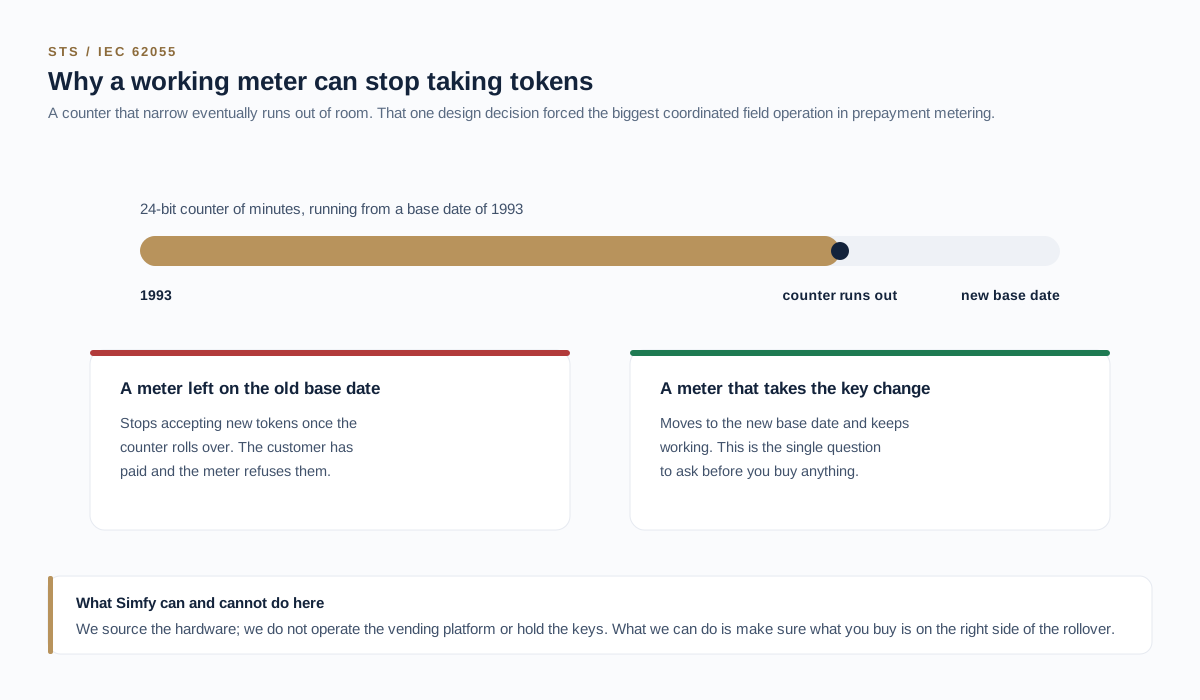
A prepaid meter has no idea what year it is. It counts minutes from a date fixed in 1993, in a field that was only ever 24 bits wide — and a counter that narrow eventually runs out of room.
That single design decision has quietly forced the biggest coordinated field operation in prepayment metering history. For anyone buying STS meters (the shared standard that lets a meter accept top-up tokens) for an estate, a utility or a housing scheme, it is also a quick way to tell a current product from an obsolete one.
We supply metering and utility management systems into East and West African markets, and this is the question we ask a supplier before any other. Simfy Exim sources these systems; we do not operate the vending platform (the system that sells and generates the top-up tokens) or hold the keys, so what we can do is make sure the hardware you buy is on the right side of the rollover (the point where the token counter runs out and restarts).
What is STS and who controls it?
STS stands for Standard Transfer Specification. It is the shared rulebook that lets a 20-digit number, bought from any approved seller, be typed into a meter and add credit to it. CLOU describes its subsequent publication by the International Electrotechnical Commission as the IEC 62055 series of specifications, with the technology licensed through the STS Association.
What makes STS unusual is that it is genuinely open at the point of sale and tightly closed at the point of cryptography. Any vendor in the network can sell a token for any compliant meter, which is what makes prepayment work in markets with thousands of small retail outlets. The security sits underneath: CLOU describes a Key Management Centre operated by Eskom in South Africa, which handles Supply Group Codes and security module initialisation, and notes that licensing through the Association ensures appropriate encryption key management practices. A meter belongs to a supply group; tokens are generated against that group’s key; nothing else will unlock it.
What is the TID and why did it run out?
Every token carries a number called the Token Identifier. According to the STS Association’s rollover material, it is a 24-bit field holding the number of minutes since a start date of 1st January 1993. A counter that size can only count so far. When it runs out it goes back to zero, and the meter stops accepting new tokens.
The TID (the serial number carried by every token) exists to stop a token being used twice. A meter remembers the identifiers it has already accepted and refuses repeats, which is what makes a token safe to print on a slip of paper and hand across a counter. That protection depends on the identifier always increasing. When the counter wraps back to zero, newly issued tokens carry identifiers the meter has already seen and treated as spent, so the meter does the correct thing and rejects them. The failure is not a bug; it is the anti-replay protection working exactly as designed, against a clock that has run out of digits.
What was the deadline, and what happens to a meter that missed it?
ESI Africa reports the deadline as November 2024, with the original base date of 1993 replaced by a new base date of 2014 that extends meter life to 2045. The same report states plainly that without the update, all existing meters will stop accepting credit tokens.
That is the whole commercial consequence in one sentence. A meter that was not updated does not fail visibly, does not alarm and does not stop supplying whatever credit it still holds. It simply refuses the next token the customer buys, and it refuses every token after that. For a utility, the failure arrives as a wall of support calls from customers who have paid and cannot get power. For an estate or a landlord running submetering, it arrives as a building full of residents with no way to top up. This is why the rollover status of a meter is a purchasing question rather than a technical footnote.
| Item | Detail |
|---|---|
| Token identifier field | 24-bit |
| What it counts | Minutes since the base date |
| Original base date | 1 January 1993 |
| New base date | 2014 |
| Deadline | November 2024 |
| Extends meter life to | 2045 |
| If not updated | Meter stops accepting credit tokens |
How big was the affected population?
Very large, and concentrated. ESI Africa cites approximately seven million prepaid electricity meters installed in South Africa, potentially growing to approximately eight million by 2024, against approximately 50 million meters currently installed globally that were affected, and approximately 70 million in total affected between the time of writing and 2024.
Those numbers explain why the transition took years rather than months, and why it shaped the market for new meters. A utility with a million meters in the field could not treat this as a firmware push. Every one of those meters represented a physical visit, a customer interaction and a support risk, and the work had to be sequenced against ordinary operations. For buyers today the practical inheritance is that the installed base and the supply chain both moved, and a meter that predates the change is not a bargain — it is a liability someone else has already decided not to carry.
How is a meter actually updated?
By visiting it. ESI Africa states that each meter has to be physically visited to clear stored TIDs and change its cryptographic key, and that the update can be performed either by dedicated employees of the utility or by the end customer.
The two-part nature of the operation is what makes it slow. Clearing the stored identifiers frees the meter to accept the new numbering; changing the cryptographic key moves the meter onto the new base date (the start date the meter counts tokens from) so that future tokens are generated correctly for it. Both steps are entered at the meter itself, which is why the customer-performed route exists at all — issuing the sequence to a household and asking them to key it in is far cheaper than sending a technician to every wall. It is also why the operation generated so much support load: a step keyed in wrongly leaves a meter in a state the customer cannot diagnose.
What should a buyer check before ordering STS meters?
Four things: that the meters are supplied on the current base date, that they are STS compliant under the IEC 62055 series, that the Supply Group Code arrangement is agreed before manufacture, and that the vending platform you intend to use can generate tokens for that group.
The Supply Group Code is the one that catches new buyers. Meters are initialised against a supply group, and a batch initialised for the wrong group is not a configuration problem you fix on site — it is stock that will not accept tokens from your vending system. That decision has to be made before the meters are keyed at the factory, which means it belongs in the enquiry rather than in the delivery discussion. We ask for it up front for that reason, and where a buyer does not yet have a vending arrangement we will say so rather than shipping meters that cannot be sold against. The same discipline runs through the rest of what we source; see supplier verification for what a factory audit can and cannot establish.
Settle the supply group and the vending arrangement before manufacture. Meters are keyed at the factory, not on site.
Prepaid or postpaid: which suits an estate?
Prepayment removes credit risk and the collection function; postpaid gives simpler hardware and a familiar billing relationship. For gated communities and rented estates in markets with high arrears, prepayment usually wins on cash collection alone.
The trade is between capital and receivables. A prepaid installation costs more per point and requires a vending arrangement to exist and keep working; in exchange, nobody consumes electricity that has not been paid for, and the awkward business of disconnection largely disappears. Postpaid is cheaper to install and needs a meter reading process, a billing run and a collections function behind it. Where an estate already has strong collection and stable tenants, postpaid with remote reading is often the calmer answer. Where arrears are the operator’s main problem, prepayment addresses the problem directly rather than managing it.
Where does the water side fit?
Alongside it, on a different metrology. YOUNIO Metering states that ISO 4064-1:2014 is identical to the corresponding edition of OIML R 49-1, and that water meters are rated by flow range rather than by any credit protocol.
The figures that matter on a water point are Q1, the minimum flow at which the meter still meets its error limits, Q3, the permanent flow rate under normal conditions, and the R-ratio that divides them. YOUNIO lists common market R-values running from R40 up to R1000, with fixed relationships of Q2/Q1 = 1.6 and Q4/Q3 = 1.25. A high R-ratio matters in residential submetering because the meter has to register the slow trickle of a dripping tap as honestly as it registers a filling bath — and unregistered trickle across a few hundred apartments is where an estate’s water losses actually live.
| Symbol | Meaning |
|---|---|
| Q1 | Minimum flow rate meeting the error limits |
| Q2 | Transitional flow, fixed at 1.6 x Q1 |
| Q3 | Permanent flow rate under normal conditions |
| Q4 | Overload flow, fixed at 1.25 x Q3 |
| R | Q3 divided by Q1 — the breadth of the operating range |
How accurate does a water meter have to be?
It depends on the accuracy class and the flow zone. BMAG Meter sets out that a Class 2 meter permits an error of plus or minus 2 per cent in the upper zone from Q2 to Q4 for water between 0.1 and 30 °C, and plus or minus 5 per cent in the lower zone from Q1 to Q2.
The same source gives Class 1 as plus or minus 1 per cent in the upper zone and plus or minus 3 per cent in the lower zone, with both classes permitted a wider margin above 30 °C — 3 per cent for Class 2 and 2 per cent for Class 1. Those lower-zone allowances are the ones an estate operator should read carefully. A five per cent tolerance on slow flows sounds small until it is applied to the hours each day when a building is only leaking rather than using, which is exactly the flow band a submetering scheme is trying to capture.
What sits behind the meter?
A vending and management layer: the platform that sells tokens, the interface residents use, and the reporting that tells an operator what is happening across a site. The meter is the smallest part of the system and usually the only part buyers specify.
An estate metering package is really three purchases stacked together — the meters, the communications, and the software that turns readings into money. Buying only the first and assuming the rest will follow is the most common way these projects stall. It is worth deciding early who operates the vending relationship, how residents top up, and what happens on a public holiday when nobody is in the office, because those answers change the hardware specification. Where water and gas points sit alongside electricity, the same question applies across all three, and a single management layer is usually cheaper than three parallel ones.
Does the origin of the meter matter?
Less than the certification and the key arrangement. An STS meter manufactured anywhere can be compliant and correctly initialised; one from a familiar origin can arrive on the wrong supply group or an obsolete base date.
We source country-agnostically. India is one important origin among the network, not the default, and we do not operate local offices or hold local stock unless the quotation says so. What we fix first is the technical and key arrangement — compliance, base date, supply group, vending compatibility, communications — then source against it so offers can be compared like for like. If the quotations in front of you use different delivery terms, FOB, CIF and DDP are not three prices for one thing.
Are new meters still affected by the TID rollover?
Meters supplied on the new base date carry the extended life the change was made to provide. The question to put to a supplier is which base date the batch is initialised on, in writing, before manufacture — not after the container has sailed.
Can a meter be moved to a different supply group later?
Supply group codes are set through a key change at the meter, so it is possible but it is a field operation on every unit. It is far cheaper to settle the supply group arrangement before the meters are made.
Do we need our own vending platform?
You need access to one that can generate tokens for your supply group. Some operators run their own; many buy the service. Either way it has to exist before the meters are installed, or you will have hardware nobody can sell credit against.
What communications should we specify?
It depends on the site. Keypad-only meters need no network at all and suit dispersed housing; automated meter infrastructure gives remote reading and remote control but needs coverage and a management layer. Decide the operating model first and let it choose the technology.
Can the same system handle water and gas?
Prepayment and management platforms commonly cover electricity, water and gas points together. Running one layer across all three is usually cheaper and far easier for residents than three separate top-up routes.
What lead time should we plan for?
Meters are initialised to your supply group during manufacture, so the key arrangement has to be settled before production starts. Plan on that agreement, then manufacturing, then sailing; the agreement is usually the step that slips.
Who is responsible if a meter rejects tokens?
It depends where the fault sits — meter, key arrangement or vending platform. This is why we put the base date and the supply group on the order confirmation: it makes the question answerable rather than a matter of assertion.
Can you supply the software as well as the meters?
We source the utility management platform, resident app and billing layer alongside the hardware where a project wants one package. What we will not do is imply we operate the vending relationship or hold the cryptographic keys, because we do not.
One management layer across electricity, water and gas is usually cheaper than three, and far easier for residents.