Aluminium vs uPVC Windows: What the Classes Mean
Choosing aluminium vs uPVC windows for a coastal or tropical project? What the air, water and wind classes really say, and which frame suits which opening.

- What do the classes on a window test report mean?
- How high do the air permeability classes go?
- What does a watertightness class like 9A actually describe?
- How is wind resistance classified?
- Aluminium or uPVC: which suits a hot coastal site?
- Why does hardware fail before the frame?
- What glass goes with the frame?
- What does the finish have to survive?
- How do fixing and sealing decide the result?
- What should be on the enquiry?
- Does the origin decide the quality?
The window that fails first is almost never the one that broke. It is the one that let water in for four years down a hidden path, until the wall behind it gave up.
Aluminium or uPVC is the question buyers ask. It is the second question. The first is what the window has to survive where it is being installed — wind pressure, driving rain, sun and salt — and whether the offer in front of you carries test evidence for those conditions or only a frame material and a price.
We source fenestration as a matched package for projects across West and East Africa and into Europe. Simfy Exim supplies windows, doors, hardware and glass; we do not install them. So the only thing that protects a buyer at our end is making sure the classification on the paperwork actually matches the exposure on the drawing.
What do the classes on a window test report mean?
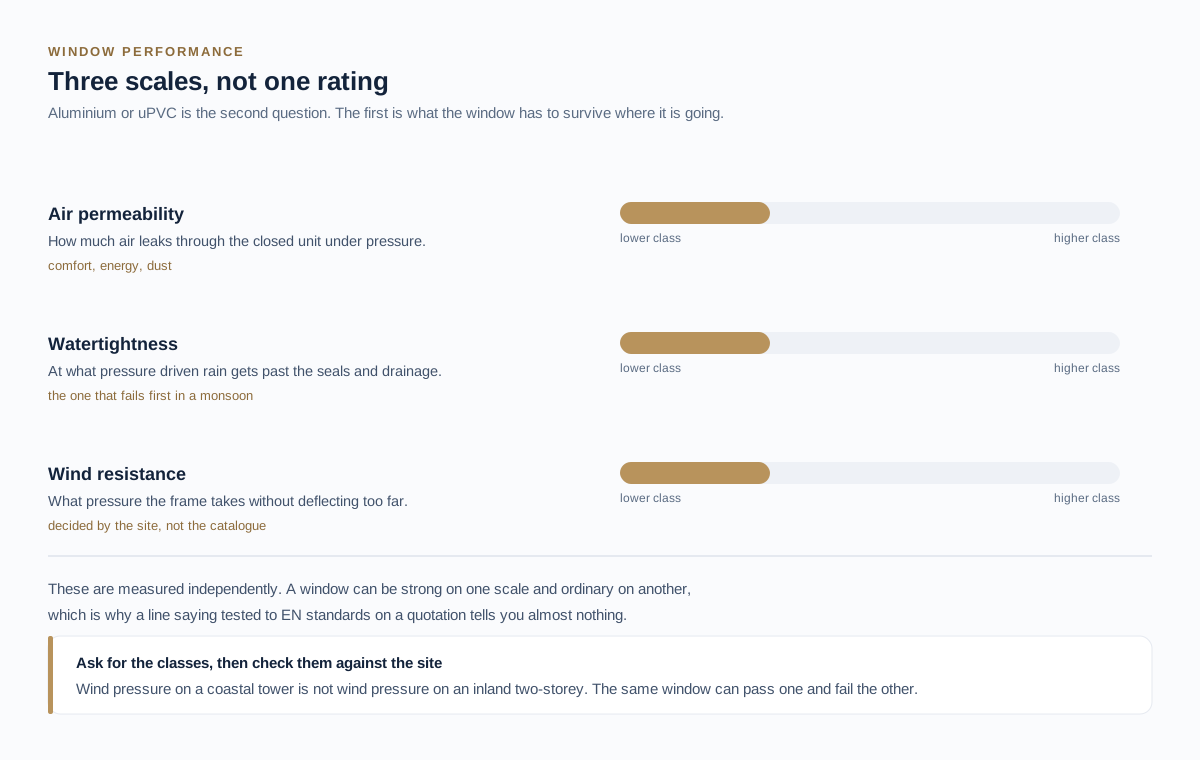
They are three separate scores, not one. How much air leaks through it. How much rain gets past it. How much wind it can take. Each is tested on its own and given its own class. A window can be very good at one and only average at another, which is why a single “tested to EN standards” line on a quotation tells you almost nothing.
The three scales answer three different questions. Air permeability asks how much air leaks through the closed unit under pressure — it governs comfort, energy use and dust ingress. Watertightness asks at what pressure driven rain starts to get past the seals and drainage. Wind resistance asks what pressure the frame can take without excessive deflection or damage. In a calm inland office block the first matters most. On an exposed coastal apartment tower the second and third dominate, and a window optimised only for air leakage will disappoint in the first storm season.
How high do the air permeability classes go?
Air leakage is scored under BS EN 12207. The BWF guide states that the scale runs from Class 0, which means it was never tested, up to Class 2 at a test pressure of 300 Pa, and that windows and doors can go higher still, up to Class 4. Sieger Systems adds that Class 4 products were tested with air pressures of 600 Pa.
Class 0 is the one to watch for. It does not mean the window leaks; it means nobody tested it. On offers assembled quickly to hit a price, Class 0 appears surprisingly often, and it is not a failure result — it is an absence of a result. For a specification that mentions air permeability at all, insist on a numbered class and the pressure it was achieved at. The step from Class 2 to Class 4 is a doubling of test pressure, and it usually reflects real differences in gasket design and sash compression rather than marketing.
What does a watertightness class like 9A actually describe?
Sieger Systems describes Class 9A as a glazing system that was unprotected and withstood 600 Pa of water pressure for 55 minutes. The BWF guide notes that classification for exposure category ranges from Class 0 to Class 7A for windows at a maximum test pressure of 300 Pa, and Class 3A for doorsets at a maximum of 100 Pa.
The letter is as important as the number. Sieger explains that classes 1 to 7 carrying a B sub-label indicate the window or door was partially protected by a balustrade or similar during the test. An A result is an exposed result; a B result assumed shelter. If a coastal tower is specified with B-class windows because the sample building had deep balconies, and your building does not, the classification has quietly stopped applying. The doorset figures matter too: a door will almost never reach the pressures a window does, which is why patio and balcony doors are the usual point of water entry rather than the windows beside them.
| Scale | What it measures | Reference points from the sources |
|---|---|---|
| Air permeability | Leakage under pressure | Class 0 = no test; Class 2 at 300 Pa; Class 4 at 600 Pa |
| Watertightness | Resistance to driven rain | Up to 7A for windows at 300 Pa; 9A = 600 Pa held 55 minutes; B suffix = partially sheltered |
| Wind resistance | Pressure and deflection | Class 5 tested to 2000 Pa; letters A to C set the accepted deflection |
How is wind resistance classified?
Sieger Systems states that a Class 5 tested product has been tested with winds up to 2000 Pa pressure, and that the letter from A to C indicates the amount of deflection accepted in the test. The number is the load; the letter is how much the frame is allowed to bend under it.
Buyers usually read the number and ignore the letter, which reverses the priority for tall buildings. A frame that carries the load but flexes generously will break the seal between glass and gasket before it breaks anything structural, and the failure appears as water and air leakage on windy days rather than as damage. On upper floors of a coastal tower, the deflection letter often matters more than the pressure class. It is also the figure most sensitive to how the unit is fixed into the opening, which is why a wind classification is a property of a tested configuration and not of a frame profile in a catalogue.
Aluminium or uPVC: which suits a hot coastal site?
Aluminium is stiffer, spans larger openings with slimmer sightlines and holds its shape in heat, but conducts heat readily unless the profile has a thermal break. uPVC insulates better as a material and resists salt, but is less stiff, so large openings need reinforcement and heavier frames.
In hot, high-sun coastal conditions the practical decision usually turns on span and shading. A large sliding unit in a living room is an aluminium job: the stiffness that lets a slim profile carry big glass is exactly what uPVC lacks without steel reinforcement inside the chamber. A run of moderate bedroom windows is often better in uPVC, where the thermal benefit is real and the spans are undemanding. Where aluminium is used in strong sun, the thermal break is not an upgrade — an unbroken aluminium frame will conduct heat straight into the room and, in air-conditioned buildings, condense on the inside. Ask what the break is made of and confirm it appears in the same test report as the classification you were quoted.
| Aluminium | uPVC | |
|---|---|---|
| Stiffness | High; slim sightlines on big spans | Lower; large spans need reinforcement |
| Heat conduction | High unless thermally broken | Low as a material |
| Behaviour in strong sun | Holds shape; finish is the variable | Colour and profile stability depend on the formulation |
| Typical fit | Large sliders, curtain wall, commercial | Moderate openings, residential runs |
| Corrosion in salt air | Depends on the coating system | Not applicable to the frame; hardware still corrodes |
Why does hardware fail before the frame?
Because the frame is the part chosen carefully and the hardware is the part chosen last. In salt air, hinges, friction stays, handles and locking gear corrode long before an aluminium or uPVC profile shows any sign of distress.
This is the single most common failure we see on coastal projects, and it is almost always a procurement decision rather than a design one. A window package is priced as a unit; the hardware is a small fraction of that price and the easiest place to save. Two seasons later the friction stays have seized, the multipoint locks no longer engage and the windows will not close tightly enough to meet any of the classes they were bought under. Specifying stainless grades appropriate to the exposure costs a little at order and removes a large maintenance liability. It is also why we quote hardware as a visible line rather than folding it into a frame price.
Send sizes, building height and exposure with it. Without exposure, no class figure can be judged generous or thin.
What glass goes with the frame?
The glass is a separate specification with its own standards, and it changes the wind and safety behaviour of the whole unit. Toughened, laminated and insulating glass units each answer different questions, and the frame classification assumes a particular glass build-up.
Substituting glass after the window is classified is a real risk. A unit tested with a laminated pane and delivered with monolithic float glass of the same nominal thickness is a different assembly under wind load. Safety requirements also travel with the location rather than the frame: low-level glazing, doors and areas near stairs generally need safety glass regardless of what the frame is made of. Send the glass schedule with the window schedule so both are quoted against one specification, not two. We handle it the same way we handle the fire package — see fire rated doorsets, where leaf, frame, seals and hardware have to be bought as one tested set.
What does the finish have to survive?
Sun and salt, in that order. The frame material decides stiffness and heat behaviour; the finish decides how the window looks and performs after five years on a facade that faces the afternoon sun and the sea breeze.
On aluminium the coating system is the whole durability story. Powder coating and anodising behave differently in strong ultraviolet and in salt-laden air, and the grade of preparation before coating matters as much as the coating itself. On uPVC the variable is the formulation: colour stability and profile behaviour under sustained heat are properties of the compound rather than of the plastic in general, which is why two visually identical white profiles from different plants can age very differently. In both cases the useful question at enquiry is not “what colour” but “what system, and what evidence is there of how it performs in this exposure”. Where a supplier can produce coating specification and warranty terms in writing, that is worth more than a shade card.
How do fixing and sealing decide the result?
A window classified to 9A watertightness in a laboratory frame can leak on day one if the perimeter seal is wrong. The classification describes the unit; the installed performance depends on the joint between that unit and the building.
This is where supply and installation responsibilities meet, and it is worth being explicit about the boundary. The tested unit arrives with drainage paths designed to take water that gets past the outer seal and return it outward. If the perimeter is sealed in a way that blocks those paths, or if the opening is out of square enough that the frame is packed unevenly, the drainage stops working and water finds the wall instead. Nothing about that failure shows in the product paperwork. Buyers who send an installation detail with the enquiry, rather than only a schedule of sizes, get an offer that can be checked against how the window will actually sit in the wall.
What should be on the enquiry?
Opening sizes and quantities, the building’s height and exposure, the required air, water and wind classes, the glass build-up, the hardware grade for the environment, and the finish. Six items, and the exposure is the one buyers most often leave blank.
Without the exposure, nobody can tell whether a 4/9A/C5 window is generous or inadequate for your building, and any price is arbitrary. We ask for it before quoting so the offer can be compared honestly against others. Where a schedule is incomplete we quote against stated assumptions and print them on the offer instead of hiding them. If you are comparing quotations that arrive on different delivery terms, FOB, CIF and DDP are not three prices for the same thing, and supplier verification covers what a factory audit will and will not tell you about a window plant.
Does the origin decide the quality?
No. The test report does. A window manufactured in India, China, Turkey or Europe can hold a valid classification; a window from a familiar origin can arrive with a report for a smaller unit, a different glass or a sheltered test condition.
We source country-agnostically for that reason. India is one important origin among the network, not the default, and we do not operate local offices or hold local stock unless the quotation says so. What we fix first is the performance envelope — classes, sizes, glass, hardware grade, finish — and then source against it so the comparison between offers is like for like. Where a required combination has no test behind it, we say so rather than offering the nearest catalogue unit and letting the site find out during the first wet season.
Is a higher class always better?
Better for the building, and more expensive. The right answer is the class that matches the exposure, which comes from height, orientation and how sheltered the facade is. Buying Class 4 air permeability for a sheltered inland courtyard is money that would do more good in the hardware.
Can we mix aluminium and uPVC in one building?
Yes, and it is often sensible — aluminium for the large sliding units and uPVC for standard openings. Keep the hardware and finish coordinated so maintenance stock is common, and make sure each type carries its own classification for the exposure it faces.
What does the B suffix on a watertightness class mean for us?
It means the test assumed partial shelter, such as a balustrade. If your facade is exposed, an A result is the one that applies to your building. Ask which suffix the quoted class carries — it is easy to miss and it changes what the number means.
How long do window packages take to supply?
They are made to the schedule, so plan on manufacturing plus sailing and freeze opening sizes before ordering. Site-measured changes after production has started are the most common cause of delay and of re-work costs on fenestration packages.
Do we need a thermal break in aluminium?
In hot climates with air conditioning, generally yes. Without it the frame conducts heat inward and can attract condensation on the inside face. Confirm the break appears in the same test report as the performance classes you were quoted, not just in the profile brochure.
Who checks the windows on arrival?
The buyer or their appointed inspector. We can arrange pre-shipment inspection as a separate line item rather than bundling it into a promise. What we will not do is describe our own goods as independently verified when nobody independent has looked at them.
What about hardware in salt air?
Specify the grade for the exposure rather than accepting a default. Hinges, stays and locking gear are the first things to fail near the sea, and the cost difference at order is small against the cost of replacing hardware across a whole building.
Can you supply matching doors with the windows?
Yes, and it is usually the better route. Doors and windows in the same facade share the same exposure, and buying them together means one classification conversation, one hardware standard and one delivery rather than three.
Windows and doors on one elevation share one exposure. Quoting them together means one classification conversation, not three.