Architectural Glass: Toughened, Heat Soaked, Laminated
Specifying architectural glass? Why toughened panes break on their own, what heat soaking really removes, and which EN product standard applies to each route.

In simple words
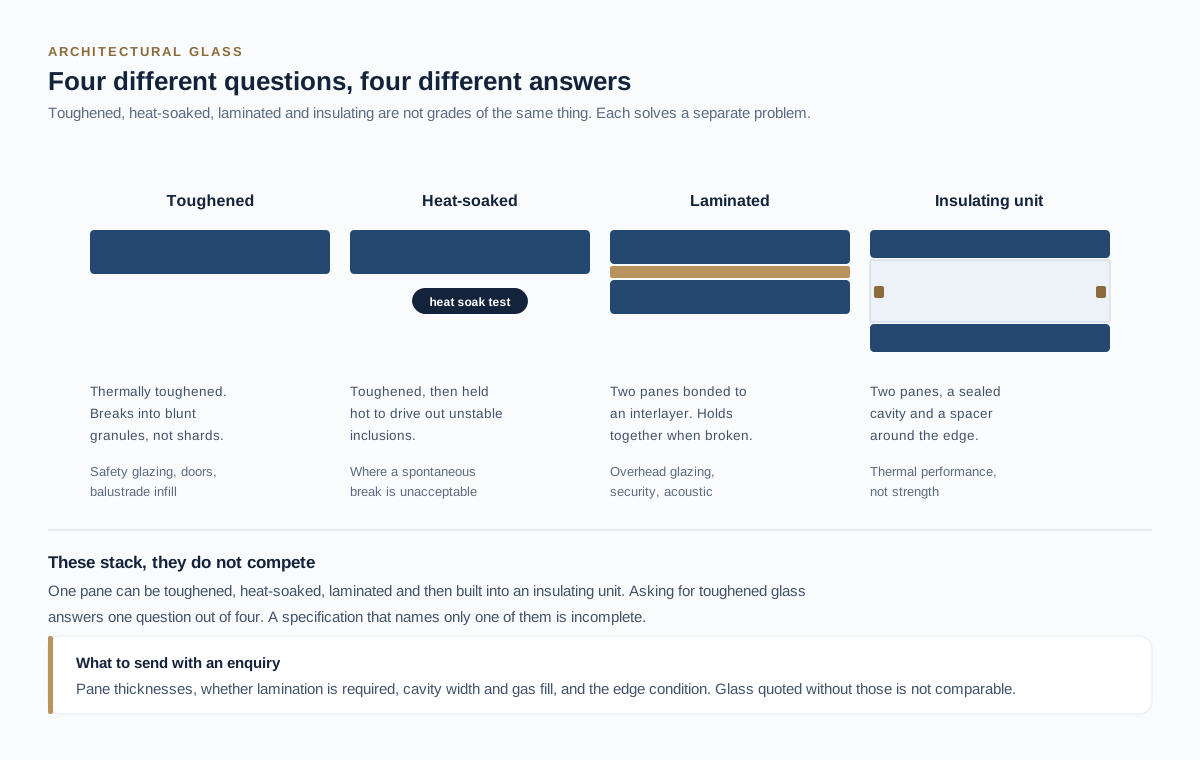
Glass is not really bought by thickness. It is bought by what was done to it. Start from what you want the glass to do:
- Want strong safety glass that breaks into small blunt pieces — ask for toughened glass, EN 12150.
- Want to cut the risk of a pane breaking on its own, years later — ask for heat-soaked toughened glass, EN 14179.
- Want glass that tends to hold together when it breaks, instead of leaving the opening — ask for laminated glass, EN 14449.
These answer different questions and are often combined. Say on the enquiry which panes are overhead or acting as a barrier: that is the item that changes the answer most, and the one schedules leave out.
- What does EN 12150 cover?
- Why does toughened glass break on its own?
- What does heat soaking actually do?
- When is laminated glass the right answer?
- What decides insulating glass unit performance?
- Which product standard applies to which glass?
- What do the numbers behind the routes look like together?
- What goes wrong in transit?
- How do glass and frame have to match?
- What should the enquiry contain?
- Does origin decide glass quality?
A toughened glass pane can break years after it was installed, on a still day, with nobody near it. Nothing hit it. A speck of contamination inside the glass finally finished changing shape.
That speck is nickel sulphide (a tiny impurity trapped inside the glass when it was made), and it is the reason the glass specification on a facade drawing is not a thickness. It is a processing route: toughened (heat-treated so it is stronger and breaks into blunt fragments), heat-soaked, laminated (glass sheets bonded to a plastic film), or a combination, chosen for what the glass has to do and what happens if it fails.
Buyers sourcing facade and interior glass usually ask for a thickness and a tint. Simfy Exim supplies architectural glass as part of a matched fenestration package; we do not install or certify it. What we can do is make sure the processing route on the order matches the risk the design carries.
What does EN 12150 cover?
EN 12150 is the European standard for toughened safety glass. Toughening squeezes the outside of the pane and stretches the middle, and that is what makes it strong. PONARC describes the result as a surface under four to six times more compression than ordinary glass, and four to five times stronger before it breaks.
Those two figures explain both why toughened glass is used and how it fails. The compressive skin has to be broken through before the glass can fracture, which is what makes the pane strong. But once a crack reaches the tensioned core, the whole stored energy releases at once and the pane disintegrates into small blunt fragments. That fragmentation is the safety property — it is why toughened glass is specified where people can walk into it — and it is also why a failure is total rather than local. A toughened pane does not crack; it stops existing.
Why does toughened glass break on its own?
Tiny specks of nickel sulphide trapped inside the glass. PONARC states that these microscopic inclusions can form during production, that they slowly change shape and grow by around 4 per cent, and that this can make a pane break on its own. The reported rate is roughly one break per 8 tonnes of toughened glass.
The mechanism is slow and completely invisible. A tiny inclusion sits in the tensioned core of the pane, and over months or years of temperature cycling it converts to a denser phase, expanding as it does. If it sits in the wrong place, the expansion is enough to start the crack that releases the pane. Nothing about the glass looks wrong beforehand and no site inspection can find it. One failure per 8 tonnes sounds negligible until you count the tonnage on a tower facade, at which point it becomes a maintenance budget and, on an overhead or balustrade application, a safety question.
What does heat soaking actually do?
It provokes the failures early, in a factory, instead of later on the building. PONARC describes the heat-soak test as holding panes at 290 ± 10 °C in a dedicated oven for around two hours, and reports a published failure-residue rate of about one in 400 tonnes of heat-soaked glass — one to two orders of magnitude lower than untreated toughened glass.
Heat soaking (an oven test that makes flawed panes fail in the factory, not on site) is not a treatment that improves the glass. It is a destructive screening process: the oven accelerates the phase change so that panes carrying a critical inclusion break inside the oven and never leave the plant. The survivors are not immune, which is why the residual rate is not zero, but the risk drops by a very large factor. EN 14179 is the standard covering heat-soaked thermally toughened safety glass, and it is the specification to name when the consequence of a spontaneous break is serious — overhead glazing, balustrades, high-level facades over public routes.
| Route | Standard | Spontaneous failure rate | Failure mode |
|---|---|---|---|
| Toughened | EN 12150 | About 1 per 8 tonnes | Whole pane disintegrates |
| Heat-soaked toughened | EN 14179 | About 1 per 400 tonnes | Whole pane disintegrates |
| Laminated | Interlayer bonded | Depends on the plies used | Fragments held by the interlayer |
When is laminated glass the right answer?
Whenever falling fragments are the problem rather than breakage itself. Lamination bonds two or more plies to a plastic interlayer, so a broken pane holds together in the frame instead of leaving the opening. It answers a different question from toughening, and the two are often used together.
The distinction matters in procurement because the two routes are frequently treated as interchangeable safety glass. They are not. Toughening controls what the fragments are like; lamination controls whether they stay in place. Overhead glazing, glass floors, balustrades and anywhere a break would drop material onto people below are lamination questions first. A vision panel at low level in a corridor is a toughening question. Where a design needs both the fragment size and the retention — a balustrade over a lobby, say — the answer is laminated heat-soaked toughened glass, and each word in that phrase is a separate cost.
What decides insulating glass unit performance?
The cavity, the coating and the edge seal — not the glass thickness. A double-glazed unit performs because of what is between the panes and what is deposited on them, and it fails because of what happens at the perimeter.
In hot climates the coating carries the load. A low-emissivity or solar-control coating reflects a large share of the heat that would otherwise arrive in the room, and the position of that coating on the surfaces inside the unit changes what it does. The edge seal is the durability story: the unit stays clear only as long as the seal keeps moisture out and, where used, gas in. A failed seal shows as condensation inside the cavity, and there is no repair — the unit is replaced. This is why an insulating unit’s warranty terms are worth reading more carefully than its stated U-value, and why cheap units on a hot, humid coastal facade are a false economy.
Which product standard applies to which glass?
Each processing route has its own harmonised product standard. Compliance Gate lists EN 572-9 for basic soda lime silicate glass products, EN 12150-2 for thermally toughened soda lime silicate safety glass, EN 14179-2 for heat soaked thermally toughened glass, EN 14449 for laminated glass and laminated safety glass, and EN 1279-5 for insulating glass units.
The list is worth keeping beside the schedule, because it is the quickest way to check that an offer describes what the drawing asked for. A quotation that names EN 12150-2 against a location the design flagged as needing heat soaking has answered a different question. One that names EN 14449 where the schedule wanted toughened has substituted retention for fragment control. And an insulating unit quoted without EN 1279-5 has been priced as two panes and a spacer rather than as a sealed unit with a durability requirement behind it. None of these are exotic errors; they are what happens when a package is priced against a thickness rather than against a route.
| Product | Product standard |
|---|---|
| Basic soda lime silicate glass | EN 572-9 |
| Thermally toughened safety glass | EN 12150-2 |
| Heat soaked thermally toughened safety glass | EN 14179-2 |
| Laminated glass and laminated safety glass | EN 14449 |
| Insulating glass units | EN 1279-5 |
Send the elevations with it. Overhead and barrier locations change the processing route, and they are the ones schedules leave unflagged.
What do the numbers behind the routes look like together?
Set side by side, the figures make the specification decision arithmetic rather than opinion: a 4 to 6 times stress increase from toughening, a roughly 4 per cent volume change in the inclusion that causes spontaneous breaks, 290 ± 10 °C for about two hours in the oven, and a fifty-fold drop in the residual failure rate.
Read as a set, they say something a product brochure does not. Toughening buys strength and a safe fragment pattern but introduces a low-probability, high-consequence failure mode that cannot be inspected for. Heat soaking does not remove that mode; it moves almost all of it into the factory, at the cost of an extra process step and the panes that break in the oven. Lamination does nothing about either but changes what happens when a pane does go. A specifier choosing between them is trading probability against consequence, and the numbers above are the only honest basis for that trade.
| Figure | Value | Source |
|---|---|---|
| Compressive surface stress vs annealed | 4-6 times higher | PONARC |
| Tensile breaking strength vs annealed | 4-5 times higher | PONARC |
| Nickel sulphide volume increase on phase change | About 4 per cent | PONARC |
| Heat soak test condition | 290 ± 10 °C, about 2 hours | PONARC |
| Spontaneous failures, untreated toughened | About 1 per 8 tonnes | PONARC |
| Spontaneous failures, after heat soaking | About 1 per 400 tonnes | PONARC |
What goes wrong in transit?
Edge damage. Glass fails from its edges, and a chip taken during handling is a crack initiation site that no inspection will call a defect. Most glass that breaks in the first year of a building’s life was damaged before it was fitted.
Packing is therefore part of the specification, not a shipping detail. Crating, interleaving, moisture control inside the crate, and how the crates are secured in the container all decide what arrives. Long sea legs into humid ports add a specific risk: moisture trapped against stacked panes causes staining that cannot be polished out, and a stained pane is a rejected pane. When we quote glass we quote the packing with it and say what the crate contains, because a saving on packing that costs one pane in twenty is not a saving. The same principle runs through the rest of the fenestration package — see how the classes work on aluminium and uPVC windows.
How do glass and frame have to match?
The window’s tested classification assumes a particular glass build-up. Substituting a different glass changes the deflection behaviour, the weight on the hardware and, in a wind test, the result — even at the same nominal thickness.
This is the most common way a compliant window becomes a non-compliant one. A unit classified for wind resistance with a laminated pane behaves differently with monolithic float of the same thickness, because the interlayer (the plastic film bonding the glass plies together) changes how the assembly bends. Heavier glass also changes the load on hinges and stays, which affects the durability of the operating hardware long before it affects the frame. Send the glass schedule and the window schedule together, so both are priced against one specification. Where doors are in the same facade, fire rated doorsets carry the same rule: the glazing is part of the tested assembly.
What should the enquiry contain?
Pane sizes and quantities, the processing route per location, the coating requirement, the intended orientation and shading, and whether anything is overhead or acting as a barrier. The last item is the one that changes the specification most and the one most often left out.
Overhead and barrier glazing are different problems from vision glazing, and a schedule that does not flag them invites the wrong quote. We ask for the elevations along with the schedule for that reason, and we will say plainly when a location looks like it needs lamination that the schedule has not asked for. If you are comparing offers on different delivery terms, FOB, CIF and DDP are not three prices for the same thing; and if you are weighing the suppliers themselves, supplier verification covers what an audit of a glass plant can and cannot show.
Does origin decide glass quality?
The processing route and the test evidence decide it. Float glass is made in a small number of very large plants worldwide and processed much more widely; the processing — toughening, heat soaking, lamination, coating — is where quality varies.
We source country-agnostically. India is one important origin among the network, not the default, and we do not operate local offices or hold local stock unless the quotation says so. What we fix first is the processing route per location, then source against it, so the commercial comparison is between equivalent products rather than between two numbers with different work behind them. Where a required combination is not something a plant can evidence, we say so instead of substituting the nearest thing they hold.
Is heat-soaked glass stronger than ordinary toughened glass?
No. It is the same glass with the same strength; the oven only removes panes that carry a critical inclusion. What you are buying is a much lower chance of a spontaneous break later, not a stronger pane.
Can we heat soak glass after it arrives on site?
No. Heat soaking is a factory process carried out on the toughened pane before glazing, in a dedicated oven under controlled conditions. It has to be ordered as part of the processing route, not added later.
Do we need lamination and heat soaking together?
Sometimes. Where a break would both endanger people below and leave an opening — overhead glazing, balustrades over public space — laminated heat-soaked toughened glass answers both risks. Elsewhere one route usually suffices.
How do we specify solar control for a hot climate?
By the performance you need rather than by a product name: how much solar heat you want rejected, how much daylight you want to keep, and how the facade is shaded. Send the orientation with the schedule so the coating can be matched to the elevation.
What lead time does processed glass need?
Toughening, heat soaking, lamination and coating are sequential factory steps, so a heavily processed unit takes longer than a plain one. Plan on the processing sequence plus sailing, and freeze the schedule before ordering; re-cutting after toughening is not possible.
Can glass be cut or drilled after toughening?
No. Any cutting, drilling or edge work has to happen before the pane is toughened. A hole added afterwards will shatter the pane. This is why dimensional accuracy in the schedule matters more for glass than for almost anything else in the package.
Who is responsible for breakage in transit?
It depends on the delivery term, which is exactly why the Incoterm on a glass order matters more than on most goods. Agree the packing standard and the term together, and make sure the insurance matches where the risk actually sits.
What arrives with the glass?
The processing evidence for the route ordered, and the packing list tied to the schedule so each crate can be matched to the openings it is for. We put the route on the order confirmation, so what was bought is not a matter of memory later.
The window classification assumes a glass build-up. Quote both against one specification so a substitution cannot quietly invalidate the class.