Fire Collars and Pipe Wraps: What the Test Covers
Sourcing fire collars for a project? What EN 1366-3 really tests, why U/U and U/C decide whether your certificate applies, and what to check before ordering.
In simple words
A plastic pipe crossing a wall is a hole waiting to open. When the pipe softens and disappears, fire goes straight through. A collar or a wrap closes that hole behind it.
Here is the part that costs people money: a product labelled “120 minutes” means nothing on its own. The rating belongs to the tested system, not to the collar in the box.
The system is the pipe material and diameter, the wall it passes through, whether the pipe ends are open or capped, and how the whole thing is fixed and supported. Change any one of those and the certificate stops describing your job. So match the certificate to the drawing, line by line, before you order.
- What does a fire collar actually do?
- What does EN 1366-3 test?
- What do U/U, U/C and C/U mean on a fire collar approval?
- What do the letters E and I mean in a classification like EI 120?
- Why does the pipe support distance appear in the certificate?
- Collar or wrap: which one does the job?
- How do European and North American approvals compare?
- What should a buyer actually check before ordering?
- Where do these systems come from?
- What goes wrong between the certificate and the wall?
A plastic waste pipe does not burn quietly. It softens, sags, and then it is simply gone — leaving a clean round hole through a wall that was supposed to hold fire for two hours.
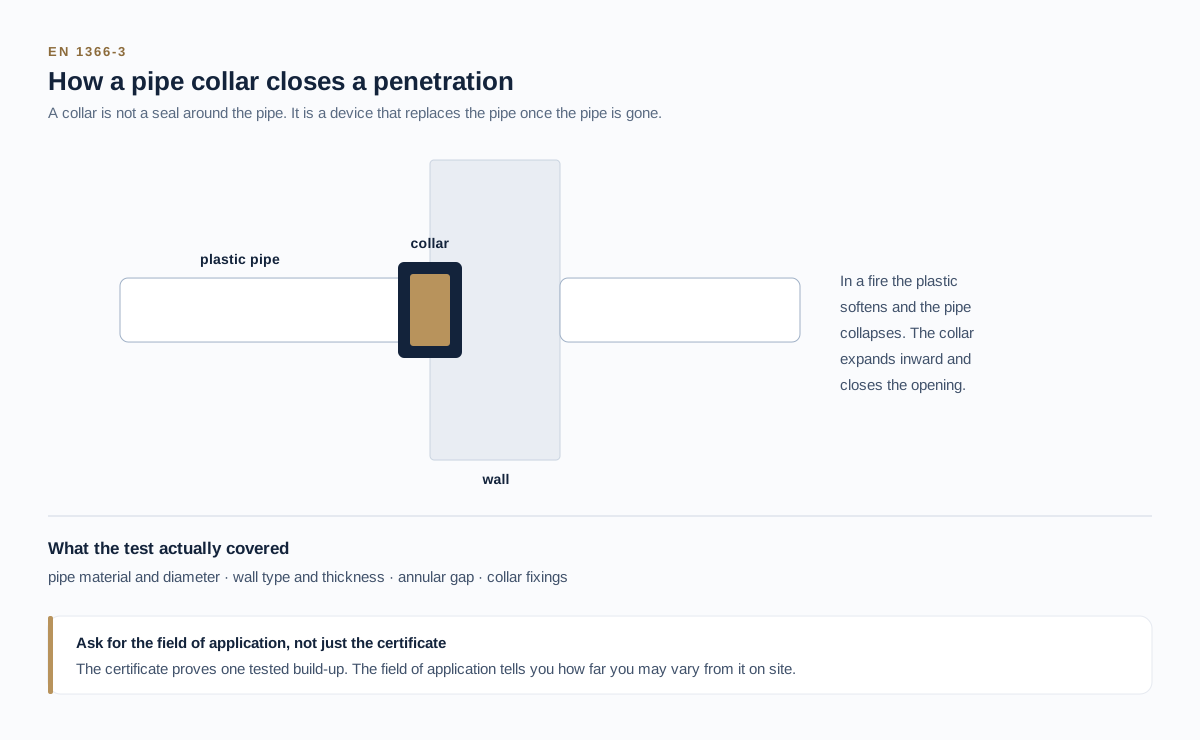
That hole is the whole problem a fire collar exists to solve. The collar is a steel band holding a strip of material that swells when it gets hot. As the pipe melts back, the strip expands inward and closes the opening the pipe left behind. It is a simple idea. Everything difficult about it sits in the testing.
Buyers who source firestop products for European and African projects usually ask us for a price and a lead time first. The question that decides whether the goods are usable on site is different: what exactly was tested, in what wall, with what pipe, and with the pipe ends open or shut. Get that wrong and you have bought a collar with a valid certificate that does not cover your detail. Simfy Exim supplies these systems; we do not install or certify them, so the only thing we can give you that matters is the right paperwork against the right drawing.
What does a fire collar actually do?
A fire collar closes the hole that is left when a plastic pipe burns away. It is a steel band with a strip inside it that swells when it gets hot. The strip squeezes the softening pipe shut and fills the opening, so flame and hot gas cannot get into the next room for the rated time.
The mechanism only works if the expansion happens faster than the pipe disappears. That balance depends on things that sound minor and are not: the pipe material and its wall thickness, the diameter, whether the collar sits on the exposed face or the unexposed face, and how the wall itself behaves as it heats. A collar sized for a 110 mm PVC waste stack in a masonry wall is not automatically correct for the same pipe in a lightweight partition, because the partition moves and cracks around the opening while the masonry does not. Manufacturers publish approvals for specific combinations, and those combinations are the product. The steel band is almost incidental.
What does EN 1366-3 test?
EN 1366-3 is the European fire test for seals around anything that passes through a wall. Hilti describes it as testing the whole solution as a complete system, not the material on its own. It covers cable seals, pipe seals, mixed openings and open or closed pipe ends.
That word “system” is doing the work. What goes into the furnace is a wall or floor of a stated construction, with a stated pipe passing through it, sealed with a stated product installed a stated way. What comes out is a result for that assembly. Change the wall from concrete to plasterboard, or change the pipe from PVC-U to polypropylene, and you are outside the test unless a separate result covers it. The same document sets practical rules for the specimen itself: Hilti notes that the distance between the perimeter of the penetration seal (the sealed hole where a service crosses a wall) and the internal surfaces of the furnace shall be not less than 200 mm at any point, which stops one seal from being shielded by the furnace wall. Test durations run in the familiar steps of 30, 60, 90 and 120 minutes.
What do U/U, U/C and C/U mean on a fire collar approval?
They describe whether each end of the test pipe was capped or left open. Promat states that U means uncapped and C means capped, with the first letter for the end inside the furnace and the second for the end outside it. U/U is the most severe case, so a system classified U/U suits any pipe end condition.
This is the detail that most often invalidates a certificate in practice, because nobody looks at it. An open pipe feeds air to the fire and lets hot gas travel down the bore to the cold side; a capped pipe does neither. Promat gives worked examples of which real services fall into which class: U/U covers plastic rainwater and ventilated sewage pipes, U/C covers plastic unventilated sewage, gas and drinking water lines as well as metal waste systems, and C/U covers metal with fire-resistant suspension and coupling systems. If your drawing shows a soil stack open to atmosphere at roof level and your supplier’s approval is U/C, the approval does not describe your building.
| Code | Inside furnace | Outside furnace | Typical service |
|---|---|---|---|
| U/U | Uncapped | Uncapped | Plastic rainwater, ventilated sewage |
| U/C | Uncapped | Capped | Unventilated sewage, gas, drinking water; metal waste |
| C/U | Capped | Uncapped | Metal with fire-resistant suspension systems |
| C/C | Capped | Capped | Least severe; rarely the only classification worth buying |
What do the letters E and I mean in a classification like EI 120?
E is integrity and I is insulation. Hilti defines E as the ability not to allow the passage of fire or the production of gas or vapour, and I as the ability to reduce the transfer of heat to the unexposed, cold side within a temperature limit. The number is the period in minutes.
An EI 120 seal and an E 120 seal both stop flame for two hours. Only the first also promises that the cold face stays cool enough not to set fire to whatever is stacked against it. In a plant room with nothing on the far side, E may be all the design calls for. In a residential corridor that people escape through, insulation is the whole point, and buying an E-only product to save money produces a seal that passes its own test and fails the building. Read the classification as a sentence, not a badge: letters first, then the period, then the pipe end code that the letters were earned with.
Why does the pipe support distance appear in the certificate?
Because an unsupported pipe pulls the seal apart as it softens. Promat requires pipes to be supported at a distance of 250 mm or less on both sides of a soft penetration seal, so the pipe cannot drop and lever the sealed joint open while the collar is still expanding.
Support spacing is the clearest example of something that is part of the tested system but gets treated on site as a plumbing decision. The same applies to local insulation. Promat sets out that where local insulation is used it must be at least A2-s1, d0, with a melting point of 1000 °C or higher, a bulk density between 40 and 150 kg/m³, and a thickness between 30 and 100 mm; steel pipes of larger wall thickness or diameter need a minimum of 1000 mm of local insulation. These are not recommendations from a catalogue. They are conditions the tested assembly met, and a delivered package that omits them is a package that has quietly left the scope of its own approval. When we quote a firestop package we list the insulation and the fixings as separate lines for exactly this reason — see how we handle firestop specification in a tender.
Collar or wrap: which one does the job?
A collar is a visible steel band fixed to the face of the wall or the soffit. A wrap is a strip of the same intumescent material (it swells when heated to close the gap) cast or pushed into the opening, hidden inside the structure. The choice is usually decided by whether the penetration is accessible and whether the finish can carry a fixing.
Collars are easier to inspect, which matters more than it sounds — a building manager can walk a service riser and see them. They need a substrate that will hold anchors, and they project into the space. Wraps disappear into the construction, suit cast-in details and situations where the surface will be plastered or boarded over, and are almost impossible to verify later without opening the wall up. On projects where handover documentation is thin, the collar’s visibility is a real advantage. On projects where a photographic record is kept as the work proceeds, wraps are often the cleaner detail. Both are tested to the same standard and neither is inherently better; they answer different questions about access.
| Surface-fixed collar | Cast-in or retrofit wrap | |
|---|---|---|
| Position | Face of wall or soffit | Inside the opening |
| Later inspection | Visible without opening up | Needs records or intrusive survey |
| Substrate demand | Must hold anchors | None |
| Suits | Risers, plant rooms, retrofit | Cast-in slabs, finished surfaces |
Send us the schedule rather than a product list. We will match each line to a classification, or tell you where none exists.
How do European and North American approvals compare?
They test the same physics and report it differently. UL 1479 and ASTM E814 are harmonised — the test method, apparatus and ratings are functionally equivalent, and a system listed under one is accepted under the other. The European route reports letters and minutes; the North American route reports F, T, L and W ratings.
Under the North American route, the F rating is the time the system prevents flame passage and burn-through and is mandatory for every penetration. The T rating is the time the unexposed side stays below a 325 °F temperature rise, and is required where combustibles on the cold side could ignite — so it plays the role that I plays in the European letters. The L rating covers air leakage and the W rating covers resistance to water passage under head pressure, which matters for horizontal assemblies and exterior applications. There is also a step with no European equivalent: after the fire exposure the assembly faces a hose-stream test, a pressurised water spray simulating fire-fighting, and it must survive both. Buyers moving a specification between markets should treat these as parallel systems of proof, never as a translation exercise.
What should a buyer actually check before ordering?
Check that the approval names your wall type, your pipe material and diameter, your pipe end configuration, and the fire period the drawing asks for — in that order. Anything the certificate does not name, it does not cover.
The order matters because it moves from the hardest thing to change to the easiest. Wall construction is fixed by the building. Pipe material is usually fixed by the services engineer. Pipe end condition is fixed by what the pipe does. Only the fire period is genuinely a specification choice, and it is the one most buyers check first. We ask for the penetration schedule before quoting rather than after, and where a classification does not exist for a combination on the drawing, we say so instead of substituting the nearest thing in the catalogue. That is also why we keep passive fire protection as a documented package rather than a product list — the documents are the deliverable.
Where do these systems come from?
Firestop manufacturing is spread across Europe, India, China and Turkey, and the approval that travels with the goods is more important than the country on the box. A product made anywhere can hold a valid EN or UL classification; a product from a well-regarded origin can arrive with a certificate that does not cover your detail.
We work country-agnostically for this reason. India is one important origin among the network, not the default, and we do not operate local offices or hold local stock unless we say so on the quotation. What we do instead is fix the technical scope first — the classification, the pipe ends, the wall types — and then source against that scope, so the commercial comparison is between like and like. If you are weighing suppliers rather than products, our note on supplier verification covers what an audit can and cannot tell you. And if the quotations you are comparing use different delivery terms, FOB, CIF and DDP are not interchangeable ways of saying the same price.
What goes wrong between the certificate and the wall?
Three things, almost always: the wrong wall type, an unsupported pipe, and a substitution made on site to keep the programme moving. None of them show up in a photograph of the finished seal, which is why they survive to handover.
Wall type is the quiet one. A classification earned in a 100 mm masonry wall does not automatically transfer to a flexible partition, because the partition deflects as it heats and opens a gap the seal was never asked to bridge. Support is the second. If the pipe is clipped at a metre either side instead of the 250 mm the tested assembly used, the pipe sags before the intumescent has finished expanding, and the seal is levered rather than crushed. The third is the substitution: a collar of the right diameter but the wrong classification, fitted because it was on the van. Every one of these is preventable at the ordering stage by matching the schedule to the approval line by line, which is slow, dull work and cheaper than opening a wall a year later.
Do fire collars expire?
The installed product does not have a shelf life in the wall, but the certification behind it does have a review cycle, and manufacturers withdraw and reissue approvals. Ask for the current classification document at the point of order rather than relying on a PDF that has been circulating on the project for two years.
Can I use one collar size for several pipe diameters?
No. The classification is tied to the diameter tested. Fitting a larger collar to a smaller pipe leaves the intumescent with more distance to travel than it was tested to close, and the result is untested. Order to the schedule, not to a rounded-up standard size.
Does a metal pipe need a collar at all?
Often not, because a copper or steel pipe does not burn away. Metal pipes usually need a seal around the annulus and, depending on diameter and wall thickness, local insulation to stop heat conducting through the pipe body to the cold side. That is a different detail with a different classification.
What lead time should I plan for?
Firestop is normally made to order in the classified combinations a project needs rather than held deep in stock, so plan on the manufacturing lead time plus the sailing, and place the order once the penetration schedule is frozen. Ordering against a draft schedule is the most common cause of re-work we see.
Who is responsible if the seal fails inspection on site?
Responsibility follows what was specified and what was installed. Our part is supplying goods that match the agreed classification with the documents that prove it; installation, workmanship and the as-built record sit with the contractor. We put the classification on the order confirmation so there is no argument later about what was bought.
Can you supply mixed penetrations with cables and pipes together?
Yes, but a mixed penetration is its own tested case under EN 1366-3, not a pipe seal and a cable seal added together. Send the schedule showing what shares each opening and we will match it to a classification that includes that mix.
How do I check a certificate is genuine?
Every classification document carries an issuing body, a report number and a date. Those are verifiable directly with the body that issued them, and we expect buyers to check rather than take our word for it. If a supplier is reluctant to give you the report number, that is the answer to your question.
We are buying for a project in Kenya. Which route do we use?
That depends on what the local authority having jurisdiction accepts, which is a question for the project’s fire consultant rather than for us. What we can do is supply against either the EN or the UL route once the design team has confirmed which one governs, and tell you honestly if a required combination has no classification behind it.
We put the classification, the pipe end configuration and the wall type on the order confirmation, so there is nothing to argue about at inspection.