Structural Steel Fire Protection: How Thickness Is Set
Buying intumescent coating for a steel frame? How section factor, critical temperature and EN 13381-8 tables decide thickness, and what to send before quoting.
In simple words
Steel does not burn. It simply gets weaker as it gets hotter, so a coating only buys time before a beam stops holding its load.
Because of that, you cannot pick a coating thickness from the fire rating alone. Three things decide it together: the size and shape of the steel member, how hot the engineer is willing to let that steel get, and how many minutes of fire resistance the building needs.
Those three numbers belong to the project’s fire engineer, not to a supplier. Simfy Exim sources coatings against them. Send the steel schedule with those figures and a real price follows instead of a guess.
- Why does steel need protecting if it cannot catch fire?
- What is a section factor and why does it change the price?
- What does EN 13381-8 actually assess?
- How is the test fire defined?
- How thick does the coating actually go?
- How much strength does steel actually lose?
- What does the fire period mean in practice?
- Intumescent coating or board: which suits the job?
- What does a buyer need to send before we can quote?
- Where should the coating be applied?
- Does the origin of the coating matter?
Steel does not burn. That is exactly why people underestimate it. It softens, quietly and predictably, and a beam that has lost half its strength looks identical to one that has not.
Every fire protection decision on a steel frame comes down to one number: the temperature at which that particular member stops carrying its particular load. Get that number and the thickness of coating follows from it. Skip it and you are buying paint by the drum instead of by the calculation.
Buyers ask us for intumescent coating (paint that swells into an insulating char when heated) by the litre and by the price. The useful conversation starts a step earlier, with the schedule of members and the fire period the design calls for. Simfy Exim sources these coatings; the specification belongs to the project’s fire engineer, and the thickness on the drawing is not something a supplier gets to adjust.
Why does steel need protecting if it cannot catch fire?
Because steel gets weaker as it gets hotter. It keeps nearly all its strength for the first few hundred degrees, then loses it fast. The temperature at which a beam can no longer hold the load it was designed for is called its critical temperature (the point where it can no longer hold its load). A coating does not stop that happening. It only buys time before it does.
The MDPI review of intumescent coating qualification states that the critical temperature ranges between 500 and 600 °C and is the one at which the steel element loses its load-bearing capacity at a specific load. That last phrase does the work. A column carrying sixty per cent of its capacity has a different critical temperature from an identical column carrying thirty per cent. The same review notes that higher critical temperatures require lower fire protection thickness, which is why a structural engineer who has done the utilisation calculation (how hard a member works against its full capacity) properly can often cut the coating bill without touching the fire rating. The saving comes out of the analysis, not out of the product.
What is a section factor and why does it change the price?
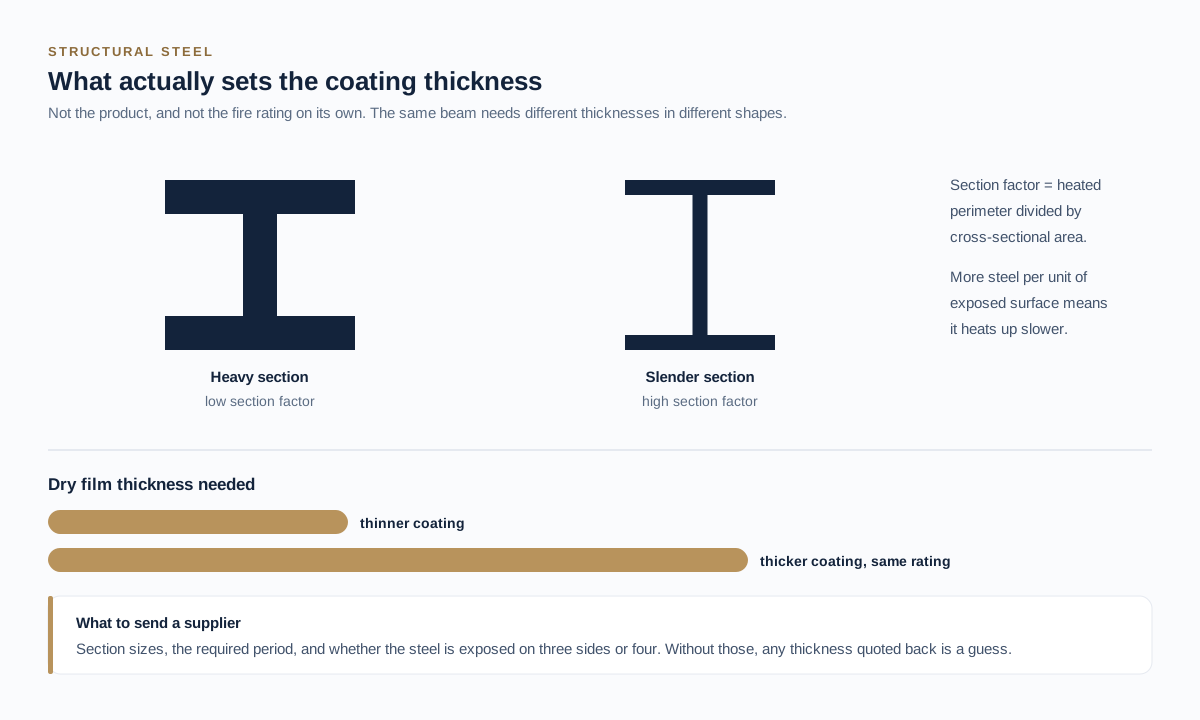
The section factor (how much steel surface is exposed relative to its mass) tells you how fast a piece of steel heats up. It compares the surface the fire can touch with how much steel there is behind it. Thin steel with a lot of exposed surface heats quickly and needs a thicker coating. A heavy chunky section heats slowly and needs less. Same fire rating, different thickness.
This is why two members with the same fire rating on the same drawing can carry very different thicknesses. A light purlin has a great deal of surface for very little metal, so heat reaches the core almost immediately. A heavy column has the opposite ratio and behaves like a thermal flywheel. Exposure matters too: a beam with a concrete slab on top is exposed on three sides rather than four, which lowers the ratio and the thickness with it. When a coating schedule arrives with a single thickness for every member on the job, that is a sign nobody has run the section factors — and it means either wasted material on the heavy sections or an unprotected slender one.
| Member | Section factor | Heats | Coating demand |
|---|---|---|---|
| Slender purlin, four sides exposed | High | Fast | Thickest |
| Beam under a slab, three sides exposed | Moderate | Medium | Reduced |
| Heavy column, four sides exposed | Low | Slow | Thinnest |
What does EN 13381-8 actually assess?
EN 13381-8:2013 specifies test methods for determining the contribution of applied fire protection systems to structural steel members. The review describes it as evaluating reactive coating performance across ranges of thicknesses, steel section factors, design temperatures and fire resistance classification periods.
Note the word ranges. The output of the standard is not a single pass or fail but an assessment across a field of conditions, which is then published as a set of thickness tables. A specifier reads into those tables with three inputs — the section factor of the member, the critical temperature the engineer has calculated, and the required period — and reads out a dry film thickness (the coating thickness once it has dried). That is the entire mechanism, and it explains why an intumescent product cannot be compared on price per litre. Two coatings at the same price may demand very different thicknesses for the same member, and the one that looks dearer per litre can be cheaper per tonne of steel protected.
How is the test fire defined?
Testing is carried out under the standard temperature-time curve specified in EN 1363-1, and the review notes that assessment may also include tests in furnaces under a slow heating curve for different fire scenarios.
The standard curve is a severe, fast-rising fire and it is what almost every published thickness table is based on. The slow heating curve matters for a narrower set of cases — smouldering scenarios, or buildings where the fire load burns for a long time at lower intensity. Reactive coatings behave differently under slow heating because the chemistry that produces the char has time to run before the steel is hot, and a product that performs well under the standard curve is not automatically the right answer under a slow one. If a project specification calls for slow-heating data, ask for it explicitly at enquiry stage; it is a separate assessment and not every product carries it.
How thick does the coating actually go?
Reactive coatings are applied at dry film thicknesses in the hundreds to low thousands of microns. The review describes intumescent systems applied with a dry thickness ranging between 400 and 3000 μm, and its own test specimens used thicknesses between 1500 and 2500 μm.
That range is enormous in practical terms. At the bottom of it, a coating goes on in a single works coat and behaves like heavy paint. At the top, it is several passes with drying time between each, and the labour and programme implications outweigh the material cost. A thickness of 3000 μm on a large steel package is a genuinely different construction operation from one at 600 μm, and it belongs in the programme discussion, not only the purchase order. This is also where site application starts to compete with off-site: applying two millimetres of coating in a controlled shop is a different proposition from doing it on a scaffold in the rain.
| Input | Comes from | Effect on thickness |
|---|---|---|
| Fire resistance period | The building’s fire strategy | Longer period, more thickness |
| Section factor | Member size and exposure | Higher factor, more thickness |
| Critical temperature | Structural utilisation calculation | Higher temperature, less thickness |
How much strength does steel actually lose?
Enough to matter well before the metal glows. Under EN 1993-1-2, the reduction factor for the effective yield strength of carbon steel is 0.78 at 500 °C and 0.47 at 600 °C. Between those two points a member loses roughly a third of what it had left.
Dlubal, in a worked interpolation from that code, uses those two anchors to derive a factor of 0.498 at 591 °C — which is the practical shape of the problem. The curve is steep in exactly the band where critical temperatures fall. A hundred degrees is not a margin; it is most of the remaining capacity. This is why a design that pins a member’s critical temperature at 620 °C rather than 550 °C is making a real structural claim, not a paperwork convenience, and why the fire engineer rather than the buyer sets it.
| Steel temperature | Effective yield strength retained |
|---|---|
| 500 °C | 0.78 of ambient |
| 591 °C (interpolated) | 0.498 of ambient |
| 600 °C | 0.47 of ambient |
Send sections, exposure, periods and the critical temperatures your engineer adopted. Four inputs turn a guess into a price.
What does the fire period mean in practice?
It is a classification period, not a promise about a real fire. Periods run in the same steps used across European fire testing — 30, 60, 90 and 120 minutes — and they describe performance under a defined furnace curve, not under whatever actually burns in the building.
Buyers occasionally read a 120-minute rating as two hours of safety. It is better read as a comparative measure: a member protected to 120 reaches its critical temperature twice as far into the standard test as one protected to 60. What that converts to in a real fire depends on the fuel load, the ventilation and the compartmentation around it, which is the fire strategy’s job rather than the coating’s. The value of the classification is that it is reproducible. Two products carrying the same period under EN 13381-8 have been asked the same question and given the same answer, which is precisely what a purchasing decision needs.
Intumescent coating or board: which suits the job?
Coating follows the shape of the steel and keeps it visible. Board encases the member in a box and hides it. Where the frame is architectural, coating usually wins; where it is buried in a riser or a ceiling void, board is often faster and less sensitive to site conditions.
The decision is rarely about fire performance, because both routes can reach the same classification. It is about what the steel is for. Exposed structure in an atrium is a design feature, and boxing it defeats the point. Steel above a suspended ceiling is invisible either way, so the question becomes which trade can work faster in that space. Coating is also more sensitive to what happens after it is applied: it needs a compatible primer beneath it and, in many cases, a topcoat above it, and damage during follow-on trades has to be made good and recorded. Board is more robust to knocks and less forgiving of complex geometry.
What does a buyer need to send before we can quote?
The steel schedule with section sizes, the exposure condition for each member, the required fire resistance periods, and the critical temperatures the engineer has adopted. Without those four, any quotation is a guess dressed as a price.
We ask for them in that form because they are exactly the inputs the thickness tables need. Where a buyer only has section sizes and a period, we can quote a range and say honestly that it is a range — but we will not pick a critical temperature on the engineer’s behalf, because that number is a structural judgement about how hard each member is working. Nor will we quote a single average thickness across a mixed frame to make the number look tidy. If you want to see how we handle this kind of scope discipline on the sealing side of the same package, our note on specifying firestop in a tender follows the same logic, and passive fire protection sets out the wider package.
Where should the coating be applied?
Off-site application gives better control of thickness, film condition and curing; site application gives flexibility and avoids transport damage. Most projects end up doing both, with a shop coat and a site touch-up regime agreed before the steel leaves the fabricator.
Thickness is the reason to prefer the shop. Reactive coatings are measured wet and checked dry, and hitting a target within tolerance across a whole frame is far easier under a roof with a calibrated gauge and a controlled temperature than it is at height. The counter-argument is handling: coated steel gets chained, lifted and bolted, and every one of those operations can break the film. A workable compromise is to apply the bulk in the shop, leave connection zones bare, and complete them on site under a written touch-up procedure with recorded readings. What matters is that somebody owns the record. A frame with no thickness readings has no evidence behind its fire rating, whatever was bought.
Does the origin of the coating matter?
Less than the assessment behind it. A coating manufactured anywhere can hold a valid EN 13381-8 assessment; one from a familiar origin can arrive with tables that do not cover the section factors on your drawing. The document is the product.
We source country-agnostically for that reason — India is one important origin among the network, not the default, and we do not operate local offices or hold local stock unless the quotation says so. What we fix first is the technical envelope: which periods, which section factor range, which critical temperatures, and whether slow-heating data is needed. Then we source against that envelope so the commercial comparison is genuinely like for like. If you are also weighing the suppliers rather than the products, our note on verifying a supplier covers what an audit can and cannot show, and FOB, CIF and DDP explains why two quotations on different terms are not two prices for the same thing.
| Figure | Value | Source standard or study |
|---|---|---|
| Critical temperature band | 500-600 °C | MDPI review of intumescent qualification |
| Yield strength retained at 500 °C | 0.78 | EN 1993-1-2 |
| Yield strength retained at 600 °C | 0.47 | EN 1993-1-2 |
| Reactive coating dry film thickness | 400-3000 μm | MDPI review |
| Thicknesses used in the review’s own tests | 1500-2500 μm | MDPI review |
| Furnace curve for assessment | Standard temperature-time curve | EN 1363-1 |
| Assessment method for reactive systems | Thickness, section factor, temperature, period | EN 13381-8:2013 |
Can I use the same thickness for every beam to keep it simple?
You can, but you will overpay on the heavy sections and you may still be short on the slender ones. The thickness table is read per member because the section factor is per member. Simplifying to one figure only works if you take the worst case across the whole frame and accept the cost.
Does intumescent coating need a primer and a topcoat?
Usually yes on both counts. The assessment is carried out on a system, and the primer beneath the reactive layer is part of that system. A topcoat is often required for appearance or for exposure, and it has to be one the coating manufacturer has approved. Mixing brands across the layers voids the assessment.
How long does intumescent coating last?
Internal, dry, undamaged and correctly topcoated, it is a long-life system. What shortens it is mechanical damage, moisture and later trades cutting or drilling through. Building in an inspection and touch-up routine matters more than the nominal durability figure.
What lead time should we plan?
The coating itself is manufactured to order in the volume a frame needs, so plan on manufacturing plus sailing. The real programme risk is upstream: the thickness schedule cannot be finalised until the structural utilisation is fixed, and that often lands later than the steel order.
Can you supply if our specification names a particular brand?
Where a specification names a product, the honest answer is that you should buy that product. Where it names a performance requirement, we can source against it. We will tell you which situation you are in rather than offering an equivalent that has not been assessed to the same tables.
What about galvanised steel?
Galvanising changes the surface the coating has to bond to and needs a primer suited to zinc. Manufacturers publish which of their primers are approved over galvanising. Send us the finish schedule along with the steel schedule so the system is quoted whole.
Do we need slow-heating curve data?
Only if the fire strategy calls for it. It is a separate assessment covering different fire scenarios and not every product carries it, so it needs to be raised at enquiry stage rather than discovered at approval stage.
Who checks the applied thickness on site?
The applicator records it and the project’s inspection regime verifies it. That sits outside what we supply, but we will say plainly that a frame without recorded dry film readings has no evidence trail behind its rating, and that the record is worth more at handover than the delivery note.
Ask instead for the thickness each product needs on your sections. The dearer litre is often the cheaper tonne.