EN 13501-1 Reaction to Fire Classes A1 to F Explained
What A2-s1,d0 actually means. The EN 13501-1 classes A1 to F, the smoke and droplet codes, the fl and L subscripts, and how to check a claim before you buy.
In simple words
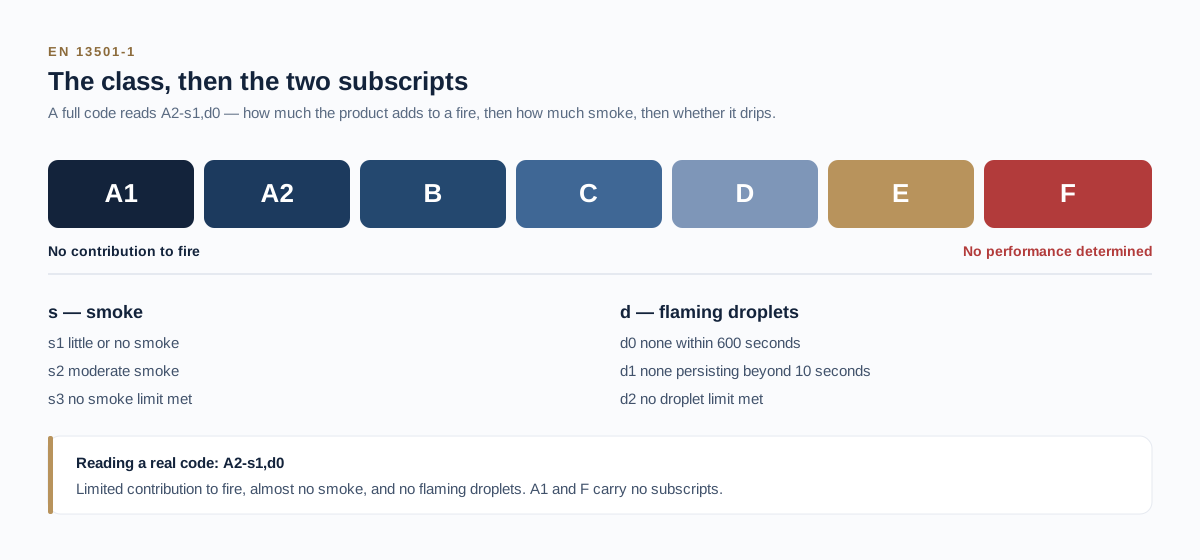
There is no European class called “fire rated”. A real class is a short string, such as A2-s1,d0, and it has three parts.
The letter, A1 down to F, says how much the material itself adds to a fire. The s number says how much smoke it makes. The d number says whether burning droplets fall off it.
So A2-s1,d0 means barely combustible, very little smoke, and no flaming droplets. Read all three parts. A quote that gives you only the letter has told you about a third of the answer.
- What does EN 13501-1 actually classify?
- What do the classes A1 to F mean?
- What do s1, s2 and s3 mean?
- What do d0, d1 and d2 mean?
- Why does A2-s1,d0 keep appearing in specifications?
- What are the fl and L subscripts?
- What is CWFT, and why does it change how you read a quote?
- How do you check a reaction-to-fire claim before you buy?
- Reaction to fire and fire resistance, side by side
- What this means for a buying schedule
- Frequently asked questions
A supplier writes “fire rated” on a datasheet and everyone relaxes. It is the least useful phrase in construction procurement, because in Europe it does not correspond to anything. There is no such class.
What exists is a string: a letter, sometimes a subscript, then a smoke code and a droplet code (whether burning bits fall off it). B-s1,d0 is a class. A2-s1,d0 is a class. “Fire rated” is a marketing line, and the gap between the two is where substitutions happen.
This is the reaction-to-fire (how much a material itself adds to a fire) side of European fire classification. It is not the same thing as fire resistance, and confusing the two is the most expensive mistake on the buying side. Simfy Exim supplies materials into projects where both are specified, so the practical question at our end is always the same: can the classification on the paperwork be traced to the product actually being shipped?
What does EN 13501-1 actually classify?
It measures how much a product feeds a fire that has already started. How easily it catches, how much heat it gives off, how much smoke it makes, and whether it drips burning bits onto whatever is below. It says nothing about how long a wall or a door holds fire back. That is a different standard, EN 13501-2.
The distinction sounds academic until a schedule is priced. Reaction to fire is a property of a material: a sheet of mineral wool, a length of timber cladding, a run of pipe insulation. Fire resistance is a property of an assembly: a wall with its fixings, a doorset with its frame and ironmongery, a damper inside its opening. A material cannot have an EI 60 rating (a fire-resistance class, not a material class) on its own, and an assembly cannot be described as A2-s1,d0 as though it were a single substance. When a tender mixes the two — “A2-s1,d0 fire doors”, “EI 30 insulation” — the specification has not been written by someone who separates them, and every quote you receive back will be answering a slightly different question. Our own guide on how passive fire protection is put together keeps the two apart for exactly this reason.
What do the classes A1 to F mean?
They run from will not burn at one end, to never tested at the other. Measurlabs sets Class A1 as non-combustible: Measurlabs lists, under EN ISO 1182, a temperature rise of no more than 30 °C and mass loss of no more than 50 % with no sustained flaming, and Measurlabs gives, under EN ISO 1716, a gross calorific potential below 2.0 MJ/kg.
A2 is the class that causes the most argument, because it is not “slightly worse than A1” in a way that scales smoothly. Measurlabs describes A2 as very limited combustibility. Measurlabs gives one route through EN ISO 1182 — a temperature rise of no more than 50 °C, mass loss of no more than 50 % and flaming duration of no more than 20 seconds — and a second through EN ISO 1716 at no more than 3.0 MJ/kg. Measurlabs adds that products other than flooring and pipe insulation must also pass the EN 13823 single burning item test at a fire growth rate of no more than 120 W/s, with total heat release over 600 seconds of no more than 7.5 MJ.
Classes B, C and D share the same two tests and differ by number. Measurlabs sets B and C at the same lateral flame spread condition and separates them on the burning item test: B at a fire growth rate of no more than 120 W/s and total heat release of no more than 7.5 MJ, C at no more than 250 W/s and no more than 15 MJ, D at no more than 750 W/s. Measurlabs records that all three also require the small flame test, EN ISO 11925-2, with flame spread of no more than 150 mm within 60 seconds. Class E is the small flame test alone — Measurlabs gives flame spread of no more than 150 mm within 20 seconds after a 15-second exposure. Class F, in Measurlabs’ words, covers products that do not fulfil the criteria for Class E.
| Class | What it means | Headline criterion |
|---|---|---|
| A1 | Non-combustible | Temperature rise ≤ 30 °C; calorific potential < 2.0 MJ/kg |
| A2 | Very limited combustibility | Temperature rise ≤ 50 °C or ≤ 3.0 MJ/kg, plus FIGRA ≤ 120 W/s |
| B | Limited contribution | FIGRA ≤ 120 W/s, THR600s ≤ 7.5 MJ |
| C | Limited contribution, higher | FIGRA ≤ 250 W/s, THR600s ≤ 15 MJ |
| D | Medium contribution | FIGRA ≤ 750 W/s |
| E | Small flame only | Flame spread ≤ 150 mm within 20 s |
| F | No performance determined | Does not meet Class E |
Two things follow from that table which buyers rarely act on. The first is that F is not a failure grade a supplier would print; it is simply the absence of a result, which is why an undeclared product and a genuinely poor one look identical on paper. The second is that the jump from A2 to B is a jump between test regimes, not a small step along a scale, so a product offered as “B or better” is offering you a substitution that may cross a regulatory line.
What do s1, s2 and s3 mean?
Smoke. Measurlabs sets s1 at a smoke growth rate of no more than 30 m²/s with total smoke production over 600 seconds of no more than 50 m², s2 at no more than 180 m²/s and no more than 200 m², and s3 as the case where neither s1 nor s2 is met.
Smoke is what actually stops people leaving a building, and the gap between s1 and s2 is a factor of six on growth rate and four on total production. Those are not adjacent grades. In a corridor, a stairwell or any single-escape-route layout, the difference decides whether a route stays usable for the time the fire strategy assumes it will. It is also the subscript most often dropped in correspondence: a quotation that says “Class B” without the smoke and droplet codes has told you roughly a third of the classification. Ask for the full string every time, in writing, before an order is placed rather than after the container is loaded.
What do d0, d1 and d2 mean?
Flaming droplets — burning material falling off the product and starting secondary fires below. Measurlabs sets d0 as no flaming particles within 600 seconds, d1 as no flaming particles persisting longer than 10 seconds within 600 seconds, and d2 as the case where neither is met.
The droplet code matters most where a product sits above something: a soffit over an escape route, a ceiling above stored goods, a facade above a means of escape at ground level. A dripping product turns one fire into several, and it does it downwards, which is the direction fire is otherwise least willing to travel. Thermoplastics are the usual concern, but the code is worth reading on anything with a polymer component — including some composite panels that carry a respectable letter class and a poor droplet code. As with smoke, the code is part of the class, not an optional annotation.
Why does A2-s1,d0 keep appearing in specifications?
Because England wrote it into law. The CIBSE Journal records that Regulation 7(2), introduced by The Building (Amendment) Regulations SI 2018/1230 and in force from 21 December 2018, requires materials in the external walls of relevant buildings with a storey at least 18 metres above ground level to achieve European Classification A2-s1,d0 or A1.
The scope is narrower than the phrase’s popularity suggests. The CIBSE Journal describes relevant buildings as those containing dwellings, institutions such as residential schools, care homes, hospitals, sheltered accommodation and student residences, or rooms for residential purposes — and it lists exempted components, among them cavity trays, door frames, window frames, membranes, seals and gaskets, thermal break materials and fire-stopping materials. That last exemption is the one that trips people up: the sealant and the collar inside a fire-stopped penetration are not caught by the ban, which is why our note on what fire-stopping has to achieve is governed by a different set of tests entirely.
For projects outside England the class still travels, because specifiers borrow it. That is not automatically wrong — A2-s1,d0 is a demanding, well-defined requirement — but it is worth knowing whether it appears in your tender because a regulation compels it or because it was copied from another document. The two situations allow very different conversations about alternatives.
What are the fl and L subscripts?
Different product families, tested in different orientations. Promat states that floorings are classified according to the same classes as construction products but are tested horizontally, with the classification letters followed by the abbreviation fl — for example A1fl.
Promat confirms that EN 13501-1 covers three families: construction products, floorings and linear pipe thermal insulation products, the last of which carries the L subscript. The practical consequence is that classes are not interchangeable across families. A1 and A1fl are not the same result, and a flooring product cannot borrow a wall product’s class because the fire was applied to it from a different direction. When a schedule lists “A2-s1,d0 throughout” and the package includes floor finishes and pipe insulation, somebody will have to translate that line into three separate requirements before it can be quoted honestly.
Send both classification reports. The field of application (the exact build-ups a class actually covers) in them is usually where the price difference actually sits.
What is CWFT, and why does it change how you read a quote?
Classification Without Further Testing. Designing Buildings describes it as a route where products meeting harmonised technical specifications receive a fire class without individual testing, published in the Official Journal of the European Union as generic product categories rather than specific branded items.
This is the part almost every explainer page leaves out, and it is the part that decides whether two quotes are comparable. Designing Buildings gives the timber default classes as D-s2,d0 for wood-based panels, structural timber, glulam, panelling and cladding, and Dfl-s1 or Cfl-s1 for wood flooring — and notes that products covered by a CWFT decision cannot claim performance beyond their default class without separate testing. So a supplier stating “D-s2,d0” for timber cladding may be quoting a generic entitlement that applies to the whole category, while another supplier stating “B-s1,d0” for a treated equivalent must be holding a test report and a classification report of their own.
Both statements can be true. They are not, however, evidence of the same thing, and a price difference between them is often explained entirely by that. The question to ask is which route the class came from.
How do you check a reaction-to-fire claim before you buy?
Ask for the classification report, not the test report, and read what it describes. A test report records what happened to one specimen. A classification report states the class and the exact product build-up, thickness range, density, substrate and fixing it applies to.
In our experience on the sourcing side, the failures are almost never a forged document. They are a genuine classification report describing a slightly different product: the same board at a different thickness, the same panel with a different core, the same cladding on a different substrate or with a ventilated cavity the report did not include. Every one of those changes can move the result, and none of them changes the product’s name. The checks below take an afternoon and are worth doing before a deposit, not after.
- The full string. Letter, subscript if any, smoke code, droplet code. Refuse partial classes.
- The report, not the summary. A datasheet quoting a class is a claim; a classification report is the evidence.
- The build-up. Thickness, density, core, substrate, air gap, fixing. Compare against what you are buying, line by line.
- The route. Tested, or CWFT generic? Ask directly. Neither answer is wrong; only the silence is.
- The family. Construction product, fl or L. Check the subscript matches the application.
- The issuing body. A named notified or approved body, with a report number you can quote back to them.
The same discipline applies to the supplier as to the paperwork. Our guide on checking a manufacturer before you commit covers the trade side of that, and writing the requirement into the tender is what stops the argument happening at delivery.
Reaction to fire and fire resistance, side by side
| Reaction to fire | Fire resistance | |
|---|---|---|
| Standard | EN 13501-1 | EN 13501-2 and the EN 1364 / EN 1366 test series |
| Applies to | A material or product | An assembly in a supporting construction |
| Question answered | How much does it feed the fire? | How long does it hold the fire back? |
| Notation | A2-s1,d0 · B-s1,d0 · Dfl-s1 | EI 60 · EI 90 (ve ho) · R 120 |
| Evidence to request | Classification report with build-up | Test evidence plus declaration of performance |
Where a product sits in both worlds, both are needed. A fire-rated doorset has a resistance class as an assembly and its facing materials have a reaction-to-fire class; protection applied to structural steel is judged on how long it keeps the section below its critical temperature, while the coating itself still has a reaction class of its own. Asking for one and receiving the other is the commonest paperwork failure we see, and it is entirely avoidable by naming the standard in the enquiry.
What this means for a buying schedule
Write the class as a string, not a sentiment. Name the standard. State the family so flooring and pipe insulation are not swept into a wall requirement. Ask for the classification report at quotation stage rather than at delivery, and compare its described build-up against the item you are actually ordering. If a supplier cannot produce one within a few days, that is information too — a real classification report is a document a manufacturer has to hand, not one they have to arrange.
None of this requires fire engineering knowledge. It requires reading a class the way you would read a dimension: completely, and against the thing being delivered.
Frequently asked questions
Is A2-s1,d0 the same as non-combustible?
No. A1 is the non-combustible class. A2-s1,d0 is very limited combustibility with the tightest smoke and droplet codes, and Measurlabs sets it at a higher permitted temperature rise and calorific value than A1. Regulation 7(2) in England accepts either, which is why the two are often quoted together, but they are separate classes and a specification asking for A1 has not been met by A2.
Does a Euroclass expire?
The class does not have a shelf life in the way a certificate does, but the evidence behind it can go out of date — the standard can be revised, the product can be reformulated, or the manufacturer can move production. Ask for the report date and confirm the current product still matches the build-up described in it.
What is the difference between a test report and a classification report?
A test report records the result of one test on one specimen. A classification report interprets those results against EN 13501-1 and states the class together with the field of application — the thicknesses, densities, substrates and fixings it covers. The classification report is the document to ask for.
Can one product carry different classes?
Yes, and this is normal rather than suspicious. The same board can be classified differently at different thicknesses, on different substrates, or with and without a ventilated cavity behind it. This is why the field of application in the classification report matters more than the headline letter.
Does a Euroclass tell me anything about toxicity?
Not directly. The smoke sub-class measures quantity and rate of smoke production, not what is in it. Toxicity is assessed under separate standards and is specified separately where a project requires it, most often on rail and marine work rather than general building.
Who can issue a classification report?
A laboratory or body accredited for the relevant test and classification standards. Ask for the body’s name and the report number, and check that the report number on the datasheet matches the one on the report itself — mismatches are more common than forgeries.
Class, family and evidence route all have to be named in the enquiry. We can help you write that line before it goes out.