UKCA vs CE Marking for Construction Products in 2026
CE marking is now accepted in Britain indefinitely. What SI 2025/1172 changed, why UKCA is optional, and what evidence a buyer should ask for instead.

In simple words
- Do you still need UKCA? No. UKCA marking remains available, but it is optional.
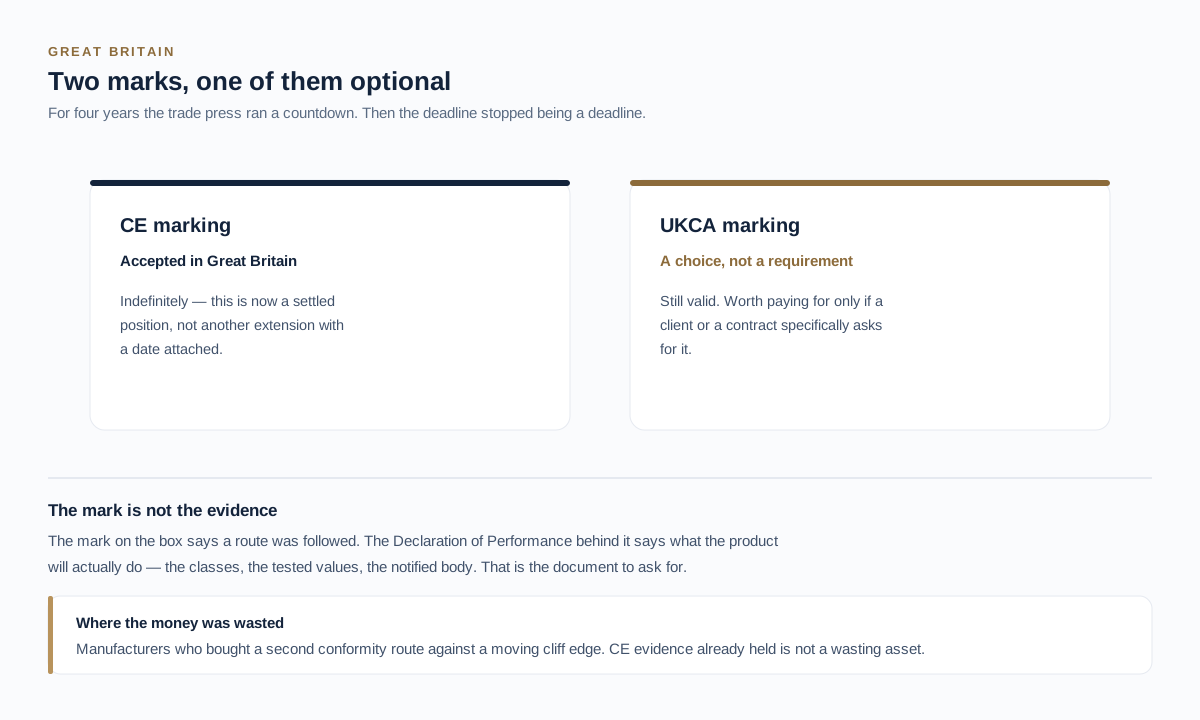
- Is CE still accepted in Great Britain? Yes. CE marking continues to be recognised for construction products in Great Britain, with no current fixed end date, and without a second UKCA assessment.
- What does that mean for a purchase order today? Do not pay for the same testing twice.
Name the route in the contract rather than writing “fully certified”, keep the declaration current and in English, and treat Great Britain and Northern Ireland as separate destinations, because Northern Ireland follows the EU regime. Any future change to CE recognition is expected to come with a transition period rather than overnight.
- Is CE marking still accepted in Great Britain?
- What actually changed, and when?
- Why did general product rules change before construction products?
- Does this mean the paperwork burden has gone?
- What is changing on the EU side?
- What the assessment system tells you that the mark does not
- UKCA and CE side by side
- What should an exporter actually do now?
- Where this leaves a buying decision
- Frequently asked questions
For four years the trade press ran a countdown. UKCA (Britain’s own conformity mark, introduced after Brexit) was coming, CE was ending, and every manufacturer selling into Britain needed a second set of certificates. Then the deadline moved. Then it moved again. Then it stopped being a deadline at all.
If you export building materials into Britain, or buy them for a project there, this is the question that has driven the most wasted certification spend since Brexit. The answer as it now stands is short. The reasoning behind it is what tells you what to do next.
Simfy Exim supplies fire protection, building materials and metering into markets that run on European conformity evidence. Our interest in this is purely practical: which piece of paper has to travel with the goods, and which one somebody paid for and did not need.
Is CE marking still accepted in Great Britain?
Yes. Brodies states that the government has confirmed CE marking (the mark showing an EU conformity route was followed) will continue to be recognised for these goods in Britain, with no current fixed end date, and that CE-marked products can keep being sold without a second UKCA assessment. In short: you do not have to pay for the same testing twice.
This is a settled position rather than another extension with a date attached, which is the part that changes commercial behaviour. Under the earlier regime a manufacturer had to weigh the cost of a parallel conformity route against a cliff edge that kept moving; the sensible response was to delay, and most did. With recognition open-ended, the calculation is different: CE evidence you already hold is not a wasting asset, and a UKCA certificate is now a choice rather than an obligation. Brodies puts the same point from the other side — UKCA marking remains available for those who prefer it, but it is optional.
What actually changed, and when?
The rule that did it is The Construction Products (Amendment) Regulations 2025. Designing Buildings identifies it as SI 2025/1172, made on 10 November 2025 and in force from 8 January 2026.
Two dates matter here for different reasons. The made date is when the text became fixed, which is what a supplier’s compliance department will have been working to. The in-force date is when the legal position changed for goods being placed on the market, and it is the one to quote in a contract or a purchase order. Anything specified, quoted or certified before 8 January 2026 was written under the old expectation, so a certificate dated 2023 or 2024 may carry a UKCA route that was bought defensively and is no longer needed.
| Fact | Value | Source |
|---|---|---|
| Instrument | Construction Products (Amendment) Regulations 2025 | Designing Buildings |
| SI number | 2025/1172 | Designing Buildings |
| Made | 10 November 2025 | Designing Buildings |
| In force | 8 January 2026 | Designing Buildings |
| CE recognition | Continues, with no current fixed end date; no additional UKCA testing | Brodies |
| UKCA status | Available, not mandatory | Brodies |
Why did general product rules change before construction products?
Because construction products were carved out. CMS records that The Product Safety and Metrology etc. (Amendment) Regulations 2024, made on 23 May 2024 and in force from 1 October 2024, removed the expiry date of CE marking recognition across 21 product regulations — and states plainly that construction products were not covered by these measures.
CMS describes the construction sector being handled separately, through a September 2024 parliamentary statement confirming that CE marking would continue to be recognised, with no fixed end date, when placing such goods on the UK market. That sequencing explains a lot of the confusion in the market during 2024 and 2025: a manufacturer selling both machinery and cladding could read one clear announcement, apply it to the whole catalogue, and be wrong about half of it. CMS also notes a government commitment to a minimum two-year transition period for any future change to CE recognition in this sector, which is the practical assurance a long-lead supply agreement needs.
Does this mean the paperwork burden has gone?
No. What changed is which mark is accepted, not whether evidence is required. The declaration, the technical file and the assessment route behind them all remain, and they are what a specifier or building control officer will actually ask to see.
This is where buyers get caught. “CE stays accepted” reads like a relaxation, and for a manufacturer that already holds a full CE route it is. For a supplier who never had one, nothing has been made easier — a product with no declaration of performance (the manufacturer’s signed statement of what the product does) is no more sellable now than it was before. Authorised Rep Compliance sets out the general shape of the GB regime: construction products require a declaration of performance rather than a declaration of conformity, technical files must describe the product and demonstrate compliance, and those files must be made available to UK market surveillance authorities in English on request. Authorised Rep Compliance also records that the UKCA route runs through UK Conformity Assessment Bodies, whose certificates are valid only in the UK.
What is changing on the EU side?
The declaration itself. Designing Buildings sets out a new EU regulation introducing an enhanced CE marking that includes environmental impact data, with a greater focus on circular economy principles, and a Declaration of Performance and Conformity — a DoPC — replacing the previous Declaration of Performance and covering a wider range of parameters.
The same source notes that the DoPC requires confirmation of conformity to environmental and climate standards, which is a genuine expansion of what a manufacturer has to be able to substantiate rather than a change of form. For anyone buying on long lead times this is worth watching for a practical reason: a document produced under the older DoP format is not wrong, but a project team expecting a DoPC will query it, and that query lands during delivery rather than at quotation stage. Ask now which format a supplier will be issuing on the goods you are ordering for next year.
What the assessment system tells you that the mark does not
How much independent scrutiny sits behind the number on the declaration. CEProCon sets out five levels — 1+, 1, 2+, 3 and 4 — and under System 4 the manufacturer carries out all assessment and verification tasks independently, with no third party required at all.
Two products can each be CE marked and each have a valid declaration while resting on completely different amounts of external checking, and that difference is recorded in the AVCP system (the level of independent checking behind a CE mark), not in the mark. CEProCon describes System 1+ as the strictest: the notified certification body (an independent body approved to assess products) conducts type testing, inspects the plant, audits factory production control continuously, and must also conduct or supervise ongoing product sampling and testing. Its examples include fire doors and fire-rated glazing, structural anchors used in concrete for critical applications, and explosive-actuated fasteners — in other words, the products whose failure nobody discovers in time.
System 1 drops the ongoing sampling; CEProCon notes the notified body performs type testing and factory production control certification with periodic audits, but is not required to carry out ongoing sampling from the market or factory after certification. Its examples run to prefabricated concrete elements, structural timber, load-bearing metal components and fire-resistant products for facades. In System 2+, CEProCon says, the manufacturer takes responsibility for type testing while a notified inspection body certifies factory production control and runs surveillance audits, and that body does not assess or certify the product’s performance directly. Curtain walling, cladding systems, some insulation and a range of flooring sit here. System 3 narrows further to type testing by a notified laboratory, with no notified body involvement in factory production control or surveillance.
| System | Third-party role | Typical products (CEProCon) |
|---|---|---|
| 1+ | Type testing, plant inspection, continuous FPC audit, ongoing sampling | Fire doors, fire-rated glazing, structural anchors |
| 1 | Type testing and FPC certification, periodic audits, no ongoing sampling | Precast concrete, structural timber, facade fire products |
| 2+ | FPC certification and surveillance only; performance not certified | Curtain walling, cladding, some insulation, flooring |
| 3 | Type testing by a notified laboratory only | Reaction-to-fire testing, sealants, blocks and masonry |
| 4 | None | Non-structural mortars, tile adhesives, decorative products |
The buying lesson is blunt. When a specification calls for a System 1+ product and an offer arrives with a System 3 declaration, both parties can honestly say the product is CE marked, and only one of them has answered the specification. Read the system number on the declaration before you read the price.
Send us the scope and the assessment body. Work commissioned purely to beat a deadline can usually be stopped before invoicing.
UKCA and CE side by side
| CE marking | UKCA marking | |
|---|---|---|
| Accepted in GB | Yes, no current end date | Yes |
| Mandatory in GB | No — either route works | No longer mandatory |
| Assessment bodies | EU notified bodies | UK Conformity Assessment Bodies |
| Certificate validity | Recognised in the EU and GB | Valid only in the UK |
| Declaration | DoP, moving to DoPC | Declaration of performance |
| Northern Ireland | Follows the EU regime | Not the route for NI |
The last row is the one most often forgotten in a shipping instruction. GB and Northern Ireland are not one market for this purpose, and a consignment split between a site in Manchester and a site in Belfast is not automatically covered by one set of documents. Settle that before the goods are booked, not when they are on the water.
What should an exporter actually do now?
Stop buying duplicate certification, keep the CE route current, and make the evidence easy to hand over. The commercial advantage in this market is no longer having two marks; it is being able to produce a complete, current declaration on the day it is asked for.
We see the same three failures repeatedly on the sourcing side, and none of them is about marks. A declaration that refers to a superseded standard. A certificate issued to a factory the goods no longer come from. A technical file that exists but not in English, which under the GB regime is the version that has to be produced on request. Any one of those turns a compliant product into a stalled delivery, and none of them is fixed by adding a second mark to the label.
- Audit what you already hold. List every product line, its declaration, its date and the standard it cites. Anything more than three years old needs checking against the current designated standard.
- Cancel work you no longer need. UKCA testing commissioned purely to beat a deadline can be stopped. Confirm in writing with the assessment body before the invoice lands.
- Name the route in the contract. “CE marked to [standard], DoP supplied with each consignment” is enforceable. “Fully certified” is not.
- Ask about the DoPC. For anything on a long lead time, find out which declaration format the manufacturer will issue at the time of delivery.
- Split GB and NI. Treat each as its own destination in the compliance pack even when they sit on one order.
- Keep the file in English. Translation on request is not the same as translation on hand.
The underlying evidence still has to be real, and for fire products it is the classification that carries the weight rather than the mark on the box — our note on how reaction-to-fire classes are written and checked covers what to read in that report. The same applies to a doorset, a fire damper or a penetration seal: the mark says a route was followed, the classification says what the product will actually do.
Where this leaves a buying decision
Britain has chosen alignment without saying so in those words. For an exporter that is straightforwardly good news — one conformity route now reaches both markets, and the money set aside for a parallel UK route can go into the evidence itself. For a buyer it removes a false signal: a UKCA mark is no longer a sign that a supplier is more serious about compliance than one without it, so the mark is a poor way to sort a shortlist. Read the declaration instead.
And treat the open-ended recognition as durable but not eternal. The two-year transition commitment CMS describes is the thing to rely on in a supply agreement — not a promise that nothing will ever change, but a promise that you will see it coming. Before committing to a supplier, our checks on verifying a manufacturer and on who carries which risk on the shipment cover the parts of the transaction that a conformity mark says nothing about.
Frequently asked questions
Do I still need a UKCA mark to sell construction products in Great Britain?
No. Brodies states that UKCA marking remains available but is optional, and that CE-marked products can circulate in Britain without a second UKCA assessment. Either route is acceptable, so the choice is now commercial rather than legal.
Does indefinite recognition apply to Northern Ireland too?
Northern Ireland follows the EU regime here, so it is not covered by the GB arrangement in the same way. Keep them as separate destinations in your compliance documents even when they appear on a single order.
Is a CE mark on its own enough evidence for a specifier?
Rarely. The mark indicates a conformity route was followed; the declaration of performance states what the product achieves, and for fire products the classification report states what it achieves in a specific build-up. Specifiers ask for the declaration, not the label.
What happens to UKCA certificates already issued?
They remain valid, and UKCA marking is still permitted. Authorised Rep Compliance notes that UK Conformity Assessment Body certificates are valid only in the UK, so a UKCA certificate does not help with an EU destination and is not a substitute for CE evidence there.
Could CE recognition be withdrawn later?
It is a policy position rather than a permanent guarantee. CMS records a government commitment to a minimum two-year transition period for any future change to CE recognition in this sector, which is what makes it usable in a long-term supply agreement.
What is the DoPC and does it affect me now?
Designing Buildings describes it as a Declaration of Performance and Conformity that replaces the previous Declaration of Performance, covering a wider range of parameters including environmental and climate conformity. If you are ordering on long lead times, ask which format the manufacturer will issue at delivery.
The two are separate destinations for conformity evidence. We can set the documentation up correctly before the goods are booked.