SIMFY Custom Sourcing
UKCA vs CE Marking for Construction Products in 2026
CE marking is now accepted in Britain indefinitely. What SI 2025/1172 changed, why UKCA is optional, and what evidence a buyer should ask for instead.
The UK asks harder questions about fire products than it did ten years ago, and it asks them earlier. That is a filter, not an obstacle, if your evidence is real.
What United Kingdom asks for
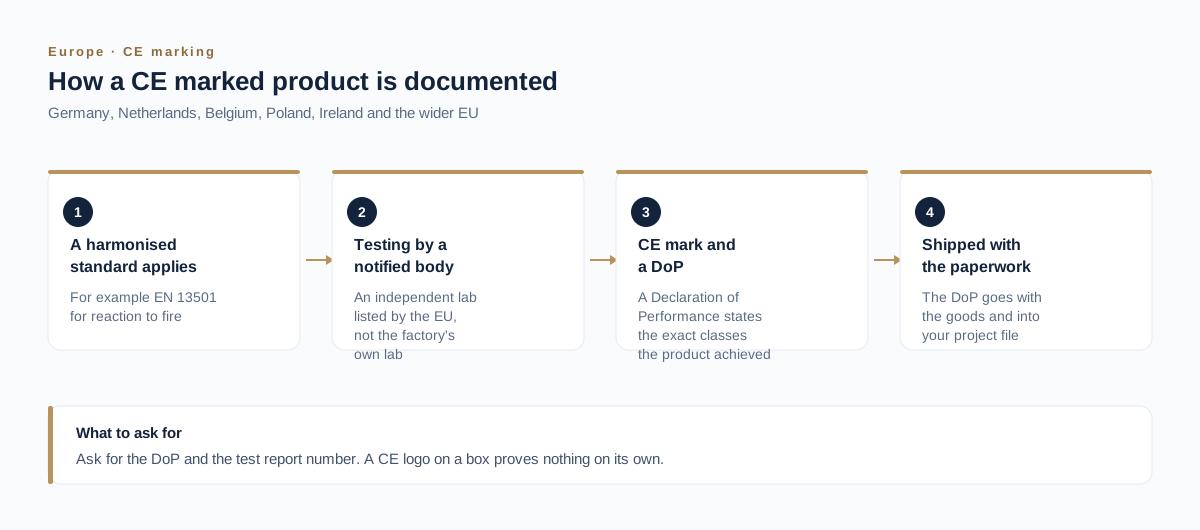
The UK has its own UKCA marking, and has said it will continue to accept CE marking for many construction products. On fire products, buyers increasingly want third-party certification and a clear line from the product on site back to the tested specimen. Confirm the current position for your specific product before shipping.
| What applies | UKCA marking, with CE marking still accepted for many construction products |
|---|---|
| What you receive | A declaration of performance and, often, a third-party certificate |
| What buyers add on fire products | Independent product certification |
| Typical fire standards | EN 13501 classification, EN 1366 test series |
| Note | Confirm the current UKCA and CE position for your product |
Product to test report to lab. Any gap is treated as a gap.
More than a self-declaration, especially on passive fire products.
Swapping a component from the tested build-up is a real issue, not a formality.
Tell us what you need for United Kingdom or see every market we ship to.
AfricaKenya · Ghana · Nigeria · Tanzania · Uganda · Côte d'Ivoire · South Africa · Africa
Europe and the UKUnited Kingdom · Germany · Netherlands · Belgium · Poland · Ireland · Europe
AmericasUnited States · Americas

SIMFY Custom Sourcing
CE marking is now accepted in Britain indefinitely. What SI 2025/1172 changed, why UKCA is optional, and what evidence a buyer should ask for instead.

SIMFY FIRESYS
What A2-s1,d0 actually means. The EN 13501-1 classes A1 to F, the smoke and droplet codes, the fl and L subscripts, and how to check a…

SIMFY FIRESYS
Sourcing fire dampers? Why EN 1366-2 is a test method and EN 15650 the product standard, what ve, ho and S mean, and what the enquiry…

SIMFY AFROBUILD
Specifying architectural glass? Why toughened panes break on their own, what heat soaking really removes, and which EN product standard applies to each route.

SIMFY AFROBUILD
Sourcing fire rated doors? What EN 1634-1 tests, what E, I, W, Sa, S200 and C0-C5 mean, and why leaf, frame, seals and closer must be…

SIMFY FIRESYS
Buying intumescent coating for a steel frame? How section factor, critical temperature and EN 13381-8 tables decide thickness, and what to send before quoting.

SIMFY FIRESYS
Sourcing fire collars for a project? What EN 1366-3 really tests, why U/U and U/C decide whether your certificate applies, and what to check before ordering.

SIMFY Custom Sourcing
About to pay a new supplier? How to verify a supplier properly: the registration check, what a factory audit sees, and the statistical limit of inspection.

SIMFY Custom Sourcing
Buying from overseas? FOB vs CIF vs DDP explained: where risk really transfers, why FOB fails for containers, and when DDP is not legally available at…

SIMFY FIRESYS
A firestop specification fails when it names a product instead of a performance. How to write the classification, evidence and substitution clauses properly.